A casino’s general operating pattern does not confirm live access or the hours of individual services inside the venue.
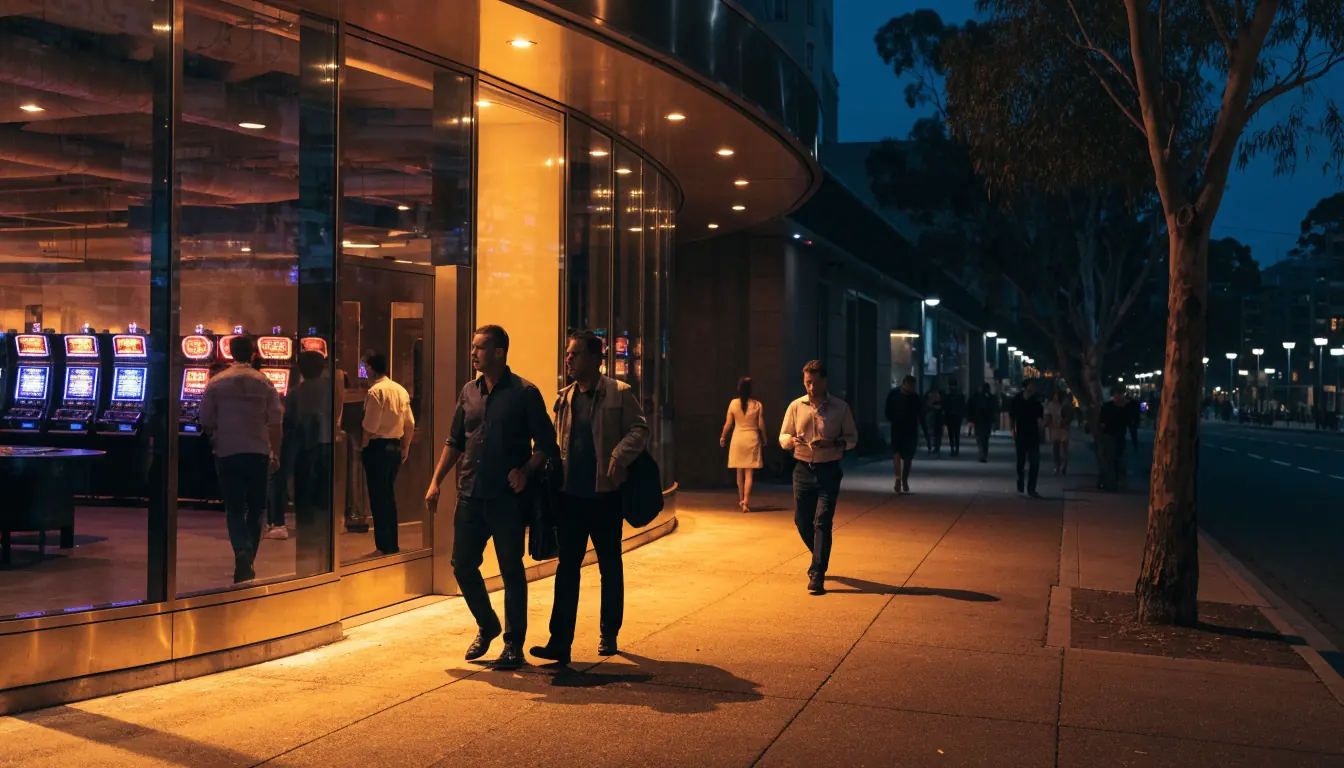
An “open now” result can describe a casino’s general operating pattern, but it does not establish the live status of a particular venue. All major Australian casinos operate around the clock. That is useful context, not a live availability check: it does not identify the closest property, confirm that a particular entrance is accessible, or establish that every service inside is operating at that moment.
I learned to separate those questions because a venue’s headline hours are designed to describe the property broadly. They are not a minute-by-minute notice about each part of it. A casino may be open while a restaurant, bar, hotel desk or entertainment space follows a different schedule. So a listing marked “open” can be accurate at the property level and still leave a practical detail unanswered.
There is another distinction behind searches for somewhere open nearby. A result may refer to a casino, a pub or another gaming venue. Those are not interchangeable categories, and the hours of a major casino cannot be applied to every place that has gaming facilities. A nearby listing that appears open is not evidence that it has the same operating pattern as a major casino.
If you’re looking for online pokies available in Australia in 2026, this list is a starting point for checking the options. Review each operator’s current availability and terms before signing up.
Uptown Pokies
Uptown Pokies is listed as operating since 2017 under a Curacao license. Its stated minimum deposit is A$20.
JustCasino
JustCasino is listed with a Curacao Gaming Control Board license. No other operator details are provided here.
WinSpirit Casino
WinSpirit Casino is listed under Curacao eGaming license OGL/2024/923/0383, issued through Antillephone N.V. Its stated minimum deposit is A$30.
MrPacho
MrPacho lists crypto payouts at 30–120 minutes and fiat payouts at 24–72 hours. Its stated minimum deposit is A$30.
Kingmaker
Kingmaker lists crypto payouts at about 90 minutes and fiat payouts at 1–5 days. Its stated minimum deposit is A$30.
DragonSlots Casino
DragonSlots Casino is listed with a Curacao Gaming Authority license under Jumpman Gaming Ltd. No other operator details are provided here.
Thor Casino
Thor Casino is listed under a Curacao license from Antillephone N.V. (Versus Odds B.V.). Its stated minimum deposit is EUR 20.
Wild Tokyo
Wild Tokyo lists crypto payouts at 30–60 minutes and fiat payouts at 1–5 days. It is listed with a Curacao license and a stated minimum deposit of A$10.
Neospin
Neospin is listed with Curacao Gaming Control Board license OGL/2023/176/0095, under Hollycorn N.V. No other operator details are provided here.
LuckyVibe
LuckyVibe is listed with Curacao Gaming Control Board license OGL/2023/176/0095, under Hollycorn N.V. No other operator details are provided here.
The wording “open now” also depends on what the listing is actually measuring. A map result might show the hours supplied for a business profile; a venue page might give general opening information; a current notice might describe a temporary change. These signals answer different questions. General hours describe the expected pattern. A current notice is more specific. Neither should be stretched into a claim about every room, service or facility on the property.
I have seen the mistake made in reverse, too: a person finds that major casinos operate 24 hours and assumes the first nearby result must therefore be open. The fact supports no such conclusion. It says something about major Australian casinos as a category. It does not say that every casino is nearby, that the result is a casino rather than a pub, or that a specific venue has no temporary interruption.
That is why “nearest” and “open” need separate checks. “Nearest” is a location question; “open” is a status question. A result can be close but have unclear or outdated hours. Another can show a clear operating schedule but be much farther away. Combining the two into a single label can hide the difference. The wording looks decisive. The information may not be.
A sensible reading begins with the venue’s identity, then its stated hours, then any current announcement that affects access. A phone call or the venue’s own current information can resolve a detail that a general listing cannot. This is not a claim that every listing is wrong; it is a recognition that a broad label is not the same thing as confirmation of a specific situation.
The word “open” can also refer to an online page rather than a physical venue. That is a different matter altogether. A website loading, accepting account traffic or appearing at another web address does not show that it is authorised to offer online casino games in Australia. Under the Interactive Gambling Act 2001, providing real-money online casino games to people in Australia is illegal for operators. The Australian Communications and Media Authority (ACMA) enforces that law and can ask Australian internet service providers to block websites offering or advertising prohibited interactive gambling services.
ACMA’s enforcement record is another reason not to treat an accessible page as proof of legitimacy. The authority reports blocking more than 1,455 illegal gambling and affiliate websites since November 2019. Published figures on illegal services withdrawing from Australia since enforcement began in 2017 do not match: one account says more than 210, while another gives a figure above 190. The difference is material; neither figure should be presented as if the sources agree.
For a physical casino, the practical meaning remains narrower. Major Australian casinos operate 24 hours a day, but the phrase does not identify which one is nearby or tell whether every part of it is available. A local result is a starting point, not a complete status report. General hours and present access are separate pieces of information.
Illegal Gambling
Under the Interactive Gambling Act 2001, providing real-money online casino games to people in Australia is illegal for operators.
A request for gaming machines available at six or seven in the morning sounds precise, but the time alone does not identify a venue or confirm that a particular gaming area is operating. It describes the intended arrival time. The useful detail is the named property and its current operating information, not the hour in isolation.
I have seen opening-time wording do too much work in people’s minds. A property described as open around the clock can still have facilities with their own arrangements. The general status of a casino is not a live report on every area inside it. Nor does a nearby result establish that its doors, gaming floor and other services are all available at the time shown.
Early searches can also blur two different questions: whether a casino is open, and whether gaming machines are available there at that exact hour. Those are not interchangeable. A venue’s own current information is the sensible reference for a planned early visit; a broad label or an old listing can describe the property without resolving the status of a particular facility.
The difference matters at six in the morning, seven in the morning or eight in the morning, because a time-focused result can look definitive even when it only gives a general description. The same applies to searches for a venue that remains open until five or six in the morning. A listed closing time may refer to the property or a specific service, and does not by itself explain the status of every area. The wording needs to be read in context.
Location gives the next useful clue. “Near me” has no fixed meaning across Australia: a result depends on where the person is and which named venue serves that area. Three properties illustrate why a single early-hours answer cannot sensibly cover every place.
Lasseters Casino is at 93 Barrett Drive in Alice Springs, in the Northern Territory. Jupiters Gold Coast Casino & Hotel is on Broadbeach Island on the Gold Coast. Country Club Casino is listed at Country Club Avenue, Prospect, in Meander Valley. These addresses place the properties in distinct locations; they do not establish a shared opening schedule or prove which one is closest to a particular person.
That distinction is easy to miss when a map result puts a venue at the top of a list. Proximity is a geographical result, not confirmation of the hour at which a particular facility is available. A property’s name and address help identify the place. Current venue information is what can clarify its operating status.
I would treat an early-hour result as a starting point, not as a promise. The details worth separating are the property’s general hours, the hours of the relevant facility, and any information specifically updated for the date of the visit. If those details are not stated together, the broadest label should not be used to fill the gap. That is where assumptions creep in.
Located at 93 Barrett Drive in Alice Springs, Northern Territory.
Located on Broadbeach Island on the Gold Coast.
Located at Country Club Avenue, Prospect, in Meander Valley.
Entry conditions are another separate matter. Major Australian casinos require valid photo identification for entry, so an early arrival does not remove that requirement. It is an entry condition, not evidence that a venue or a particular area is open. Keeping those questions apart avoids mistaking one confirmed detail for another.
There is no national early-morning timetable that can be inferred from these three addresses. A venue in Alice Springs, one on the Gold Coast and one in Meander Valley are not interchangeable simply because the same time appears in a search. The location identifies the property; its current information establishes what is available at the intended hour. No shortcut.
Good Friday changes the question from whether a gaming venue normally operates to whether a particular property keeps its usual arrangements on that date. All major Australian casinos operate around the clock, but that general pattern does not confirm a specific venue’s Good Friday schedule. A broad opening-hours description and a date-specific arrangement are not the same thing.
I learned to separate those two things because “open” is a blunt word in venue information. It can describe the property as a whole while leaving the status of a particular area or service unstated. On a public holiday, that distinction matters more than usual: a general operating pattern is useful background, not a holiday notice.
A Good Friday visit therefore needs confirmation from the venue’s own current information. The detail to look for is not merely a statement that the casino operates 24 hours. It is a notice that applies to the relevant date and property. If that notice is unclear, the general pattern should not be treated as a promise that every part of the venue will be available as usual.
Small wording differences carry weight. “Open” may refer to the main property, while a date-specific update may set out different arrangements for particular facilities. The words do not necessarily conflict; they may be answering different questions. One describes the broad operating model, the other the arrangements for a particular day.
The same reading applies when the date is described as “today” or “tonight”. Those words do not identify a fixed schedule: their meaning changes with the calendar and the time of checking. A result that gives ordinary hours can still leave the holiday question unresolved. On a date such as Good Friday, the relevant detail is whether the venue has published an arrangement for that day, not whether a general page describes its standard operation.
Other public holidays can create the same need for a property-specific check, but one date cannot stand in for another. An arrangement stated for Good Friday does not establish what happens on a different holiday, and a general statement about round-the-clock operation does not fill that gap. I have seen how easily a broad line in a listing becomes, in a reader’s mind, a guarantee about the whole venue. It is not.
The practical distinction is simple: a casino’s normal operating pattern gives context; a holiday notice gives date-specific information. If the venue’s public information does not clearly address the date, there is no sound basis for assuming its usual arrangement applies unchanged. That is not a claim that the venue will be closed. It is a limit on what a general hours statement can establish.
This is especially relevant when information is copied between listings. A directory may preserve a standard description long after a venue has published a temporary update, or it may describe the property without covering every facility. The wording may be accurate in its own narrow sense and still be insufficient for planning a holiday visit. Date first. Property second. General pattern last.
The same caution applies to a search for a venue open on Good Friday nearby: proximity does not settle holiday hours. A nearby property may have a different notice from another venue, even where both belong to the same broad category. The date and the specific property remain the deciding details. A 24-hour operating pattern is useful context, but it is not a substitute for that confirmation.
No blanket answer is reliable for every property and every public holiday. The defensible answer comes from the venue’s own date-specific information. General hours are context. Holiday arrangements are separate.
“Nearest” is a geographic question before it is an opening-hours question. Australia’s distances make that distinction important: a map can show a gaming venue in the same state, or even the same broad region, without making it a practical local option. The useful comparison is between the actual starting point and named venues nearby, not between a location and a national list.
The market is spread across the country. A specialist review of Australian gambling locations counts 147 cities with gambling and lists more than 20 full-scale casinos across all eight states. Those figures describe a wide distribution, not an even one. A city count does not tell how many venues are close to a particular suburb, and a national casino count does not identify which property is closest to a home, workplace or trip destination.
Sydney gives a sense of how much local concentration can vary. The same kind of specialist location review identifies Sydney, New South Wales, as Australia’s largest gambling city, with 11 gambling facilities. That is a city-level count, not a promise that all facilities sit together or are equally accessible from every part of Sydney. In a spread-out urban area, the nearest listed venue can still be a considerable journey from the point where the search begins.
I have seen location descriptions make a venue sound closer than it feels in practice. A city name is broad; a suburb or street address is more useful. For instance, a listing for a gaming venue in Redcliffe needs to be read as a specific local result, rather than evidence that Redcliffe represents the wider Brisbane area or that a venue elsewhere in the region is nearby. Place names alone do not settle the distance.
A specialist review identifies Sydney, New South Wales, as Australia's largest gambling city, with 11 gambling facilities.
The same applies when a map labels a result “nearby.” That label depends on the location being used and on which places the listing includes. A result may represent a full-scale casino, another type of gaming venue, or a facility within a larger property. The wording on the listing matters. A pin on a map is a starting point, not a substitute for checking the venue’s exact address and what kind of facility it is.
For a closest-venue comparison, the practical sequence is straightforward: establish the relevant suburb or town, identify the venue’s address, then compare the route rather than relying on a city-wide label. In regional areas, the nearest option may lie outside the town named in the search. In large cities, several facilities may be listed, but the city’s overall count will not tell which one is closest to a particular address.
That is why a national overview and a local result answer different questions. The overview shows that gaming facilities exist across a broad Australian footprint, while a local listing narrows the choice to a place that can be assessed by its address. Neither the national spread nor Sydney’s concentration determines what is nearest elsewhere.
A location count is not a route.
Yes. All major Australian casinos operate 24 hours a day. That is the clearest answer to whether a major casino can be open through the night and into the next day. It describes the operating pattern of major casino properties across the country, rather than a special schedule at one named venue.
I have found that the important distinction is the scope of the statement. “Open around the clock” refers to the casino’s general operation. It does not establish that every gaming venue in Australia follows the same pattern, or that every part of a major casino is available at every hour. A property may contain different facilities, and the general operating description should not be stretched into a promise about each one.
That is where a simple answer can become misleading. The broad fact is useful: major casinos do not operate on the assumption of a standard daily closing time. But it cannot identify the status of a particular service, area or activity inside a property. Nor does it establish the operating hours of a smaller gaming venue simply because that venue is nearby or belongs to the same broad industry.
I used to treat “24 hours” as a complete description. It is not. It answers one question about the property’s overall operation, while leaving the details of individual facilities separate. That distinction matters because a venue’s headline status and the availability of a particular feature are not interchangeable.
Attention: A 24-hour operating pattern refers to the casino's general operation and does not guarantee that every internal facility or smaller gaming venue is open continuously.
The wording also does not mean that every location described as a casino is a major casino, or that every gambling-related venue is covered by the same evidence. A search for a place that stays open all night may return different kinds of businesses. The nationwide statement applies to major Australian casinos; it should not be applied automatically to every result or every gaming venue.
So, for someone asking whether there are 24-hour casinos in Australia, the answer is yes. For someone asking whether every nearby venue, room or facility operates continuously, the general answer does not settle that narrower point. The label has limits. Short version: yes, with scope.
“Near me” sounds like a simple distance question. In Australia, it also points to a market organised by state and territory. A casino property operates under a licence issued by the jurisdiction where it is located, so the local setting is not just a label on a map. It is the framework in which that property is authorised to operate.
That distinction matters when a broad national result is treated as if it described one local venue. Australia does not have a single national casino licence covering every property. Each location sits within its own state or territory system. From behind the counter, I found that people often grouped venues together because they shared a brand or a familiar name. Operationally, the local licence is the more useful dividing line.
A specialist casino review describes Australia as having more than 20 full-scale casinos across all eight states. That is the review’s market count, not a permanent official total: venues and classifications can change. The useful point is the spread, not the precise tally. A result for one city cannot stand in for every property across the country.
The word “pokies” can also blur the distinction between a casino and other gaming venues. A location result may identify a gaming facility without establishing that it is a casino property. Those categories should not be swapped casually. The licence belongs to a specific property, and a nearby result is only relevant if it identifies the venue actually being considered.
I would read “near me” as a request for local context, not as proof that a listing is current, open to the public, or covered by the same arrangements as another venue. The name and address need to match the intended property. A nearby place in another jurisdiction remains subject to its own local framework. Close on the map; separate in regulation.
The year in the wording does not turn a national description into a live status report. It dates the question, but the meaningful detail remains property-specific: which venue, where it is, and which jurisdiction issued its licence. That is the level at which the Australian casino market is organised. A country-wide count can sketch the landscape; it cannot resolve the details of one local listing.
A late-night visit can look simple on a map: a major Australian casino operates around the clock, so the building is open. I learned to separate that headline from the smaller operational decisions behind it. A casino’s general hours describe the property, not necessarily the status of every gaming area, restaurant, bar, or other facility at a particular moment.
Major Australian casinos require valid photo identification for entry, and the minimum age for entry across Australia is 18.
That distinction matters after midnight. “Open” may mean the casino remains in operation, while a particular service has its own hours or is temporarily unavailable. The broad operating pattern cannot confirm which facilities are accessible during a late visit. Nor does it promise that every part of the venue is running in the same way throughout the night.
The wording on a sign or website can make this less obvious. “Open 24 hours” is a statement about the casino’s operating pattern; it is not a guarantee that every facility is open continuously. From the other side of the counter, that was the distinction most likely to get lost when a general headline was treated as a complete schedule. One headline, several schedules.
Entry conditions remain separate from opening hours. The minimum age for casino entry across Australia is 18, and valid photo identification is required for entry to major Australian casinos. Being open late does not change either condition.
For a late visit, the useful check is therefore specific: confirm the property’s current status and the hours of the particular facility intended for use. A general 24-hour statement answers whether a major casino operates around the clock; it cannot settle every detail of a late-night visit. That is not a contradiction. It is how a large venue’s operating hours differ from the schedule of each service inside it.
Christmas Day can make a general opening-hours answer misleading. All major Australian casinos operate around the clock, but that broad pattern does not confirm how a particular property is arranged for the holiday. The distinction matters: a casino’s usual operating model and its published Christmas Day information are not the same thing.
I would not treat “open 24 hours” as a holiday notice. It describes the general operation of major casinos; it does not, by itself, settle whether a named venue has made a date-specific change. Nor does it establish that every part of a property follows the same schedule. That is where a short search result can leave out the detail that matters.
For a Christmas visit, the useful check is the venue’s own current information for that date. A general listing may show normal hours, while a holiday notice may address Christmas Day specifically. If the venue’s page is unclear, contacting the property is a more reliable way to resolve the uncertainty than relying on a broad statement about Australian casinos. Keep the date explicit when checking: ordinary daily hours are not a substitute for Christmas Day arrangements.
This is also why an answer to “are pokies open on Christmas Day near me?” cannot be settled by the national 24-hour pattern alone. “Near me” identifies a location, but the holiday detail belongs to the individual venue. The name of the property and its own notice are the deciding information.
The practical point is simple. Major casinos operate 24 hours, but that fact should not be stretched into a guarantee about a specific Christmas schedule. Check the venue, not the assumption.
Anzac Day can make a simple opening-hours answer misleading. Major Australian casinos operate around the clock, but that general pattern does not establish how a particular venue handles the day. Holiday arrangements are specific to the property; a national operating pattern is not a substitute for checking the venue’s own current information.
I have seen the distinction matter at the counter: “open” can describe the casino overall, while the terms of access on a public holiday may be different. The short answer is not a promise. Confirm the particular venue’s Anzac Day arrangements before setting out, especially when the trip depends on a specific entrance or facility being available.
The Northern Territory gives the location question some useful context. A specialist gambling-industry directory lists three casinos across three cities in the Territory, rather than a single central venue serving every town. That count is a snapshot from a directory, not a permanent guarantee of the current market. For a venue in Alice Springs, Lasseters Casino is at 93 Barrett Drive; its address identifies the property, but does not by itself confirm its holiday schedule.
The same distinction applies to searches for nearby gaming venues more broadly. A result can identify a casino in the region, and the major-casino pattern can explain why round-the-clock operation is common. Neither detail settles a venue’s arrangements for Anzac Day. The property’s own notice is the relevant check.
I would treat a general opening-hours label as a starting point, not the final word on a public holiday. It describes the broad operating picture; the date-specific detail belongs to the individual venue. Short distinction.
Wording about cash or cheques can make a venue sound as though its payment arrangements are settled and easy to compare. It does not establish which payment methods a particular gaming venue accepts, whether a cheque can be used, or what conditions apply. Those are operational details, not conclusions that follow from a venue being open.
I learned to separate the headline from the transaction. A sign or a short description may mention a payment option, but the wording alone does not tell the whole story: availability can depend on the venue’s current procedures. Nor does it guarantee that a payment will be processed in a particular way. “Cash and cheques” is a description to verify with the venue, not a promise about every service inside it.
“Top rated” has a different weakness. It sounds like a measured judgment, but without knowing who rated the venue, what was assessed and when, the label says little about quality. A rating is not an opening-hours confirmation, and it cannot establish that one venue is better suited to a particular visit. Polished wording is not a method.
The licensing record is more concrete, though it answers a narrower question. Across Australian casinos, venue licences endorse the number of gaming machines, and the combined installed total is 3,308. That figure is a regulatory record, not a score, recommendation or guarantee about payment facilities. It also should not be mistaken for a count of every kind of service available at a venue.
From the counter side, these distinctions matter because customers often treat one label as proof of another. A venue may have a recorded licence condition; that does not settle its current payment arrangements or validate a promotional rating. Check each claim on its own terms. Different questions, different evidence.