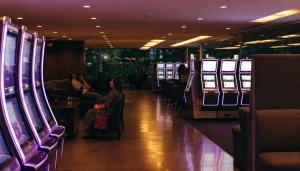
The guide separates map proximity from venue information, online legality and opening-hour claims that require confirmation at the source.

A map pin can answer one narrow question: where a place is. It cannot, on its own, establish whether a venue has pokies, whether they are available to play, or whether the machines suit someone’s preferences. That distinction matters when looking for a nearby venue around Central Sydney. Distance is easy to display; the details that shape a visit require separate confirmation.
I learned to treat location as a starting point, not a recommendation. A result described as close to the CBD may be a short walk, a longer walk through busy streets, or simply nearby by car. The word “nearby” has no fixed meaning without a route and a point of reference. Central Sydney covers more than one possible starting place, and a result can look close on a screen while being awkward to reach in practice.
The same caution applies to searches for pokies near me in Sydney. A phone’s location setting can narrow the map, but it does not verify the information attached to each listing. A venue name, address and map marker tell little about its gaming area. Even an apparently relevant listing may not answer whether pokies are installed, whether access is restricted, or whether the venue’s current arrangements match the description.
There is a difference between a venue being nearby and pokies being available there. A venue might appear in a general category without that listing confirming its machines. A reference to gaming facilities may also be broad, old or incomplete. A precise pin is not proof of precise information. It is only a precise pin.
“Convenient” is another word that can conceal the gap. In venue descriptions, it often means that a place is easy to find or close to a transport route. It says nothing reliable about the number or type of machines, the atmosphere, or whether a particular pokie is operating. Those are separate questions, and proximity cannot answer them. Marketing language does not fill the evidence gap.
 Regional Pokies: Australian City and State SearchesExplore regional searches for Australian pokies and casinos, from city and state terms to online play, live dealers, keno and payout topics.
 Online pokies in Australia: legality, payments and bonusesLearn how the Interactive Gambling Act treats offshore operators and what withdrawal checks, bonus turnover and payment methods do—and do not—tell you.
I also avoid treating popularity as a substitute for detail. A venue can appear prominently on a map or receive many reviews without those signals confirming the quality or current availability of its pokies. Reviews may describe food, service or a past visit rather than the gaming area. A high rating is not a machine inspection. A busy listing is not an operational update.
For a useful comparison, the information needs to be tied to the venue itself and recent enough to reflect its current setup. The address should match the place being considered; the venue should confirm whether it has pokies and whether the relevant area is accessible. If the intended visit depends on a particular feature, that needs direct confirmation too. Otherwise, the comparison is mainly about geography, not the experience being sought.
This is where “best pokies in Sydney” can become misleading when treated as a location question. A nearby venue is not automatically the best one, and a result farther away is not automatically worse. Without reliable venue-level details, ranking places by distance creates a false impression of comparison. The map has done its job. It has not reviewed the machines.
My practical rule is plain: use a map to work out where a venue is, then confirm venue-specific details through the venue’s own current information. If that confirmation is absent, keep the conclusion narrow. The place may be nearby. The rest remains unanswered.
That is not a flaw in the map. It is a limit of what location can prove. A short route may matter for planning, but it cannot establish availability, quality or suitability. Proximity is a useful filter, not a verdict.
A search for online pokies in Sydney can make a web-based game look like a simple extension of a local venue. Legally, those are different things. The Interactive Gambling Act 2001 prohibits operators from providing real-money online casino games, including pokies, to people in Australia. No Australian online casino licences have been issued, so there is no locally licensed online casino to distinguish as the lawful option.
Legal Risk
The Interactive Gambling Act 2001 prohibits operators from providing real-money online casino games, including pokies, to people in Australia. No Australian online casino licences have been issued.
That matters more than the wording on a website. A business may describe itself as international or point to a licence issued elsewhere, but that does not make its real-money pokies lawful to provide to customers in Australia. The law is aimed at the operator, not at an individual for playing. That distinction can be easy to miss when a site presents account access, deposits and games as routine.
I have seen how the presentation can do the work of reassurance: familiar payment labels, polished terms and a menu that resembles a conventional casino. None of those features changes the legal position. Nor do they establish that a site is licensed in Australia. “Available” is not the same as authorised.
Offshore sites may accept Australians, but access is not a sign of domestic approval. The Australian Communications and Media Authority (ACMA) enforces the Interactive Gambling Act and blocks access to illegal offshore gambling sites; internet service providers must comply with its blocklist. A site loading today does not settle whether it is lawful to serve Australian customers, or whether it will remain reachable.
The risk is also not confined to the moment of deposit. If an offshore casino refuses to pay winnings, an Australian player has no legal recourse in Australia to compel payment. That is a practical weakness of dealing with a business outside the domestic licensing system: a complaint cannot be treated like a dispute with an Australian-licensed casino, because there is no such online casino.
 Best Pokies in Tasmania: Venue Hours and ChecksLearn how to check gaming-room hours, venue-level information and travel details, and why a venue being open does not mean its pokies…
 Online Pokies for Real Money in Australia: Legal FactsLearn how offshore access differs from Australian licensing and why PayID is not approval. No Australian online casino licences have been issued.
Searches for Sydney casino pokies online, real-money games, or a no-deposit offer can blur that difference. The phrase “no deposit” may sound like there is nothing at stake, but it does not remove the legal issue around the operator or guarantee that any winnings can be withdrawn. A promotional label is not a safeguard. Nor does a claim about high limits or a maximum bet tell anything reliable about the operator’s status or the enforceability of its terms.
Cashless pokies raise a related but separate question. A cashless payment method describes how money moves; it does not grant a casino permission to provide prohibited online gambling. PayID is a payment mechanism, not proof of licensing, fairness or transparency. A payment going through cannot resolve the legal or contractual risks attached to an offshore site.
The law’s focus on operators should not be mistaken for an endorsement of offshore play. It means the individual player is not the target of the Interactive Gambling Act in the same way as a company supplying the service. It does not create an Australian regulator that can make an offshore operator pay, preserve an account balance or enforce its advertised conditions.
BetStop also has a defined boundary: it applies to Australian-licensed operators and does not bind offshore sites. Since there are no Australian-licensed online casinos, it should not be treated as a block on offshore casino accounts. The mechanism has a purpose, but not that one.
Attention: If an offshore casino refuses to pay winnings, an Australian player has no legal recourse in Australia to compel payment.
That is the central practical distinction for anyone comparing online results with physical venues around Sydney: a page that accepts an Australian user is not evidence of a local licence, and an offshore licence is not an Australian one. I would not read a bonus, a cashless option or an advertised payout as a substitute for that protection. The domestic route does not exist. The exposure does.
A venue’s opening hours and its pokies hours are not necessarily the same thing. A hotel, club or other venue may be open for meals, drinks or other services while its gaming area is unavailable. The reverse can also happen: a listing may show a venue as open without saying whether pokies are operating at that time.
That distinction matters when a search suggests an early start or a late finish in Sydney. A result labelled “open” is a useful lead, not confirmation that machines are switched on. Listings can be out of date, refer to the venue as a whole, or omit changes to gaming-room access. Even an accurate general schedule may not cover a particular day.
I learned not to treat a venue’s advertised hours as a machine timetable. They answer different questions. “Open” may mean the doors are open; it does not necessarily mean the gaming area is accessible or pokies are available. The detail that matters is the current operating time of the pokies themselves.
The sensible check is therefore specific: look for a current statement from the venue about gaming-area or machine hours, rather than relying only on a general business listing. If that detail is not published, contact the venue and ask whether pokies will be operating at the intended time. This is more reliable than inferring availability from opening hours or from a result that simply says the venue is open.
There is one operating-related staffing point worth separating from the timetable. Region Riverina reported that, from 1 July, venues operating more than 20 gaming machines would need a dedicated responsible gambling officer (RGO) on duty while those machines are running. That requirement concerns staffing during machine operation; it does not establish when any particular Sydney venue opens its gaming area. Nor does it mean that the venue is open at a particular hour.
Searches for pokies available at a specific time can also mix together several different things: the venue’s public opening, entry to the gaming area, and whether machines are operating. A page that answers only the first may look complete while leaving the actual question unresolved. Small wording differences matter. “Venue open” is not the same as “pokies operating.”
The same caution applies when a listing gives a closing time. It may describe the whole venue, a particular service, or information that has not been updated. It should not be read as proof that pokies remain available until that time. Where a late or early visit depends on machine availability, the venue’s own current information is the decisive detail.
A stated payout percentage is another separate matter. It cannot be inferred from opening hours or from the fact that a venue has pokies. Timetable information says when a service may be available, not what settings apply to a game. Those are different checks, and combining them in one listing does not make either answer more definite.
From behind the counter, the practical distinction is plain: the building’s schedule is not the gaming floor’s schedule. Search results can narrow down what needs checking, but they cannot turn a general opening time into confirmation of machine operation. For a particular morning or evening, only a current, venue-specific answer settles that point.
Choosing a pokies site for Sydney in 2026 means checking the details that matter to you before you play. This list gives you a concise reference to the information available for each operator.
Uptown Pokies
Uptown Pokies has operated since 2017 and lists a Curacao license. Its minimum deposit is A$20.
JustCasino
JustCasino lists a license from the Curacao Gaming Control Board.
WinSpirit Casino
WinSpirit Casino lists Curacao eGaming license OGL/2024/923/0383, issued through Antillephone N.V. Its minimum deposit is A$30.
MrPacho
MrPacho lists crypto payouts at 30–120 minutes and fiat payouts at 24–72 hours. The minimum deposit is A$30.
Kingmaker
Kingmaker lists crypto payouts at around 90 minutes and fiat payouts at 1–5 days. Its minimum deposit is A$30.
DragonSlots Casino
DragonSlots Casino lists a Curacao Gaming Authority license, with Jumpman Gaming Ltd named in connection with it.
Thor Casino
Thor Casino lists a Curacao license through Antillephone N.V., with Versus Odds B.V. named in connection with it. Its minimum deposit is EUR 20.
Wild Tokyo
Wild Tokyo lists a Curacao license. Its stated payout speeds are 30–60 minutes for crypto and 1–5 days for fiat; the minimum deposit is A$10.
Neospin
Neospin lists Curacao Gaming Control Board license OGL/2023/176/0095, with Hollycorn N.V. named in connection with it.
LuckyVibe
LuckyVibe lists Curacao Gaming Control Board license OGL/2023/176/0095, with Hollycorn N.V. named in connection with it.
“Best” is doing too much work when it is used to describe pokies. It might mean a game has a return-to-player (RTP) setting someone considers attractive, that its features suit a particular style of play, or simply that it produced a memorable win. Those are different claims. A result from one session cannot establish that a game pays better, and a game-level comparison cannot establish which Sydney venue offers the best experience.
RTP is a useful point of comparison only when the figure applies to the version actually available. A specialist review reports that some providers give casinos a choice of RTP settings for a pokie, so the same title may carry different return percentages in different places. That makes the game’s name an incomplete guide. A figure found in a review or description should not automatically be treated as the setting used by every casino offering that game.
Even when the applicable setting is known, RTP is not a forecast for an individual session. It describes a theoretical return across play, not a schedule of wins or a promise that a particular amount will come back. A higher stated figure cannot tell anyone when a win will happen, how large it will be, or whether a short session will finish ahead. Those are not details the percentage resolves.
Each spin is determined by a Random Number Generator and is an independent random event. The previous result does not make a win more or less due on the next spin. A run of losses is not evidence that a payout is about to arrive; a recent win does not mean another is more likely to follow. That distinction is easy to lose when a game’s animations, near-misses or bonus rounds make separate outcomes feel connected. They are not.
The phrase “best paying” therefore needs a careful reading. It can point to an advertised RTP setting, but it can also be shorthand for someone’s personal experience or an impression created by a few visible wins. Those meanings are not interchangeable. A comparison based on a declared setting is at least a comparison of a stated game parameter; a story about a winning session is an anecdote, not evidence of a repeatable advantage.
The same caution applies to claims about pokies in Sydney CBD or elsewhere in the city. A location does not establish which RTP version is configured, and a venue name does not settle how a particular game will perform. That is a question about the game’s actual configuration, not a ranking of neighbourhoods or casinos. Without reliable details for particular titles and settings, naming a “best” game would create precision the evidence cannot support.
Each spin is determined by a Random Number Generator and is an independent random event; previous results do not make a win more or less due on the next spin.
My own test for a useful comparison is plain: identify what is being compared, distinguish a stated setting from a personal result, and leave randomness out of any promise. A number can describe a configuration. It cannot turn chance into certainty.
A request for pokies at Sydney Airport sounds precise, but the location label does not establish that a particular venue there has pokies, or that machines are available at a given time. The same applies to North Sydney.
Airport searches can also blur distinct meanings: inside the airport, close to it, or somewhere along a journey to or from it. Those are not interchangeable. A result associated with the airport area does not, by itself, show that the machines are on airport premises. Nor does proximity establish access, current availability or the conditions attached to play. The distinction matters. A map pin can look definitive while answering none of those practical questions.
North Sydney has a similar problem. The suburb name narrows the geography, but it does not identify a confirmed venue or say whether pokies are operating there. A broad directory entry, an old listing or a place described as nearby can all create an impression of certainty without settling the point.
“Convenient” is often doing more work than it admits. It can mean close to a terminal, easy to reach from a station, or simply included in a search result. None of those descriptions confirms that a venue has pokies. They also do not establish whether entry is available, what the venue’s arrangements are, or whether a machine can be used on arrival. Geography is a starting point, not a service specification.
The same caution applies to searches for pokies in Sydney city. The phrase can cover a wide area, and results may mix the central city with neighbouring districts. I have seen how a short location label can be mistaken for an endorsement. It isn’t one.
A separate search for the maximum cash payout on pokies in Sydney needs machine-specific evidence, not a city-wide guess. The location alone cannot establish a maximum, and a general figure would imply a uniform rule across venues and machines. No neat shortcut.
The practical standard is simple: separate the area being searched from a confirmed venue, and separate a confirmed venue from claims about its machines or payouts. Sydney Airport and North Sydney are useful geographic descriptions. They are not, on their own, evidence of a particular pokie, its availability or its cash payout.
A name can make a venue sound like a settled answer. “Crown Sydney pokies” appears to point to a particular place, but the phrase itself does not confirm what machines are available, whether they are operating, who can access them or what conditions apply. I would not turn that label into a review.
That distinction matters because venue details are not interchangeable. A building’s name does not establish that a particular pokie room exists, that it is open at a given time, or that every visitor can enter. Nor does it establish the range of machines or the terms attached to play. Those are separate claims, and each needs current, venue-specific confirmation.
Search wording such as “Crown Sydney casino pokies” can also blur several questions together. It might mean the location of the machines, the quality of the room, access arrangements, or simply whether pokies are present. A result that repeats the venue name may look authoritative while answering none of those points. Labels are not operating details.
I have seen how promotional language does its work: “premium” describes an impression, not a measurable feature; “best” is a verdict, not proof. Without confirmed information about the machines and the conditions in which they are offered, neither word supports a meaningful comparison. Calling somewhere the best pokies room in Sydney would require more than a recognisable name.
The useful standard is specific evidence. A claim about availability needs to refer to current machine availability; a claim about access needs to state the relevant conditions; a claim about hours needs to distinguish the venue’s opening from the operation of its pokies. These are different pieces of information. One does not establish the others.
A visit also involves more than the machine list. The practical details that affect a decision—entry, operating arrangements and any conditions set by the venue—should be confirmed through Crown’s own current information before plans are made. An old review or a copied directory entry may describe a past arrangement rather than the one in force now.
So a Crown-specific description should stay narrow unless it can be substantiated: the venue name alone is not a machine guide, an access guarantee or a ranking. No comparison follows from the label.
A venue’s reputation, décor or number of machines does not tell the whole story about how its pokies are managed. For clubs and other venues, the more useful distinction is between what can be seen on the floor and the operating obligations that apply behind it. Those obligations are not a ranking, and they do not establish which Sydney venue is “best”.
One reported requirement concerns larger gaming rooms. Regionriverina.com.au reported that, from 1 July, a venue operating more than 20 gaming machines must have a dedicated responsible gambling officer (RGO) on duty while those machines are running. The same report described a one-month grace period for venues to remove signage and bring in the required officers. These are reported operating requirements, not evidence that any particular Sydney club has a certain number of machines or that an RGO is present at a particular time.
That distinction matters when comparing venues. A club may have pokies, but the existence of machines alone does not show whether the RGO threshold applies. Nor does a venue’s public description establish its current staffing arrangements. The rule is conditional: the machine count determines whether the dedicated-officer requirement applies, and the officer’s duty is tied to the period when the machines operate.
From 1 July, venues operating more than 20 gaming machines are required to have a dedicated responsible gambling officer on duty while those machines are running, following a one-month grace period for signage and staffing updates.
A responsible gambling officer is a venue role, not a badge that makes play safe or removes the possibility of harm. The practical point is that a qualifying venue must have a designated person on duty during machine operation. That creates an identified responsibility within the venue rather than leaving all responses to chance or to whichever staff member happens to notice a problem.
The reported grace period also matters because a requirement can have a transition phase. A venue’s signage or staffing may not change at the same moment a rule is announced. I have seen operational changes treated as paperwork until the day they affect a shift; the working detail is who is rostered, and when. Not the slogan.
A separate reported obligation is the keeping of a gambling incident register. It is intended to record occurrences, including situations where a patron’s behaviour suggests they may be at risk of gambling harm or already affected by it. A register is a record of incidents, not a public scorecard of how responsibly a club runs its gaming area. Its presence would not prove that a venue has prevented harm; its absence from public view would not show whether an internal record is being maintained.
For someone assessing a club, these requirements are more meaningful than broad claims such as “responsible gaming” or “member-focused”. Such phrases describe an image. The operational questions are narrower: whether the venue falls within the RGO rule, whether the required officer is on duty when the machines are operating, and how incidents are recognised and recorded. Those details may need confirmation directly with the venue or the relevant regulator; a listing or promotional description is not a substitute.
Self-exclusion is one of the recognised responsible-gambling tools, alongside deposit limits, loss limits and session time limits in settings where those tools apply. It is distinct from a venue’s incident register: one is a measure intended to restrict access, while the other records certain occurrences. Neither should be treated as proof that a particular venue’s procedures are effective in every case.
BetStop has a specific boundary: it applies to Australian-licensed operators and does not bind offshore sites. That limitation is important when interpreting self-exclusion information, although it does not establish a venue’s own procedures. In a club setting, self-exclusion arrangements and staff responses are matters to check with the venue rather than infer from the presence of pokies or a general responsible-gambling statement.
Searches for Sydney clubs with pokies often compress several issues into one phrase: machines, venue atmosphere, access and safeguards. They are separate questions. A club’s suitability cannot be settled by its location or by a general label such as “best”; operating rules offer a more concrete basis for understanding what the venue is expected to do, but they do not supply a venue-by-venue comparison.
I would treat responsible-gambling language as a starting point, not a conclusion. The useful evidence is specific and operational: which requirement applies, who is responsible during machine operation, and whether incidents are recorded under the reported rules. That is less glamorous than a ranking. It is also more informative.
“24-hour” is a precise claim, not a loose way of saying that a venue stays open late. For pokies, it raises a second question: whether the machines are operating throughout the venue’s stated opening hours. Those are not automatically the same thing.
I learned to separate three details that are often collapsed into one: the venue’s opening hours, the hours when its gaming area is accessible, and the hours when pokies are available to play. A page showing a venue as open does not, by itself, settle the latter two. Nor does a general statement about late trading establish uninterrupted access.
That distinction matters when checking whether a Sydney venue is open now. “Open” can refer to the venue as a whole; the relevant area may have different arrangements. A timetable can also be specific to a day, public holiday or temporary change. The useful confirmation is a current statement from the venue itself that addresses both access and machine operation, rather than a broad label attached to a map result or directory entry.
I would treat an all-hours claim as something to confirm, not infer. Check the venue’s own current hours and, where the wording is unclear, contact the venue and ask whether pokies are operating at the time in question. If the answer only confirms that the premises are open, the machine-hours question remains unanswered.
There is no special meaning hidden in the phrase “24-hour pokies Sydney”: it describes an expectation about continuous access, not proof that a particular venue provides it. A schedule is evidence of stated hours; a direct confirmation can clarify whether those hours apply to the gaming area. Neither should be stretched into a promise that conditions cannot change.
Keep the distinction simple: venue hours, gaming-area access, and pokies operating hours. Confirm the detail that matters before setting out. Open premises are not the same as available machines.
A reference to Parkes alongside Sydney does not, by itself, identify a particular venue or even settle which place is meant. Place names can be shared, shortened or used as part of a venue name. I would not turn that ambiguity into a confident local recommendation.
The same caution applies to broad requests for pokies in Sydney. A city label can describe a large area, but it says nothing about which venues have machines, whether those machines are operating or what a visit would involve. A result that appears relevant is not proof of any of those details. That distinction is easy to miss when listings place a name, a map marker and a few promotional words together.
“Best” is also incomplete without a clear basis for comparison. It might mean a convenient location, a particular atmosphere or a feature of the machines. Those are different judgements, and a location phrase cannot establish them. I have seen how a neat label can make a listing feel more informative than it is. The detail still has to hold up.
For a Parkes-related result, the sensible first step is to establish the exact venue and location being discussed, rather than infer either from the wording alone. Then the venue itself is the place to confirm whether it operates pokies and what conditions apply. For Sydney-wide results, the same principle holds: check the specific venue, not just the city attached to a listing.
This is not a ranking, and it is not a claim that a particular Parkes venue exists. It is a boundary on what the place names can prove. Sydney identifies a broad destination; Parkes may narrow a phrase, but not necessarily enough to identify a machine room or a venue. Without confirmation at venue level, a confident recommendation would be guesswork.
Yes, Australians can legally play on offshore sites that accept them, but operators are prohibited from offering real-money online pokies to Australians without a domestic licence, and no such licences have been issued. The law targets operators, not individual players.
It is the total amount you must bet before bonus winnings can be withdrawn. For example, a $500 bonus with a 40x requirement means $20,000 in bets; if the requirement applies to a $500 deposit plus a $500 bonus at 35x, it means $35,000 in bets.
There is no Australian-licensed online casino, and a foreign licence or polished website does not make an operator locally authorised. If an offshore casino refuses to pay, Australian players have no legal recourse in Australia to compel payment.
Compare the bonus with the wagering required before withdrawal, and check for cash-out caps on free-spin winnings. For example, a $500 bonus with a 40x requirement requires $20,000 in bets, while a 35x requirement on a $500 deposit plus a $500 bonus requires $35,000.