Bitcoin changes how funds are handled, not the slot format; Australian access also raises questions about offshore operators and real-money play.
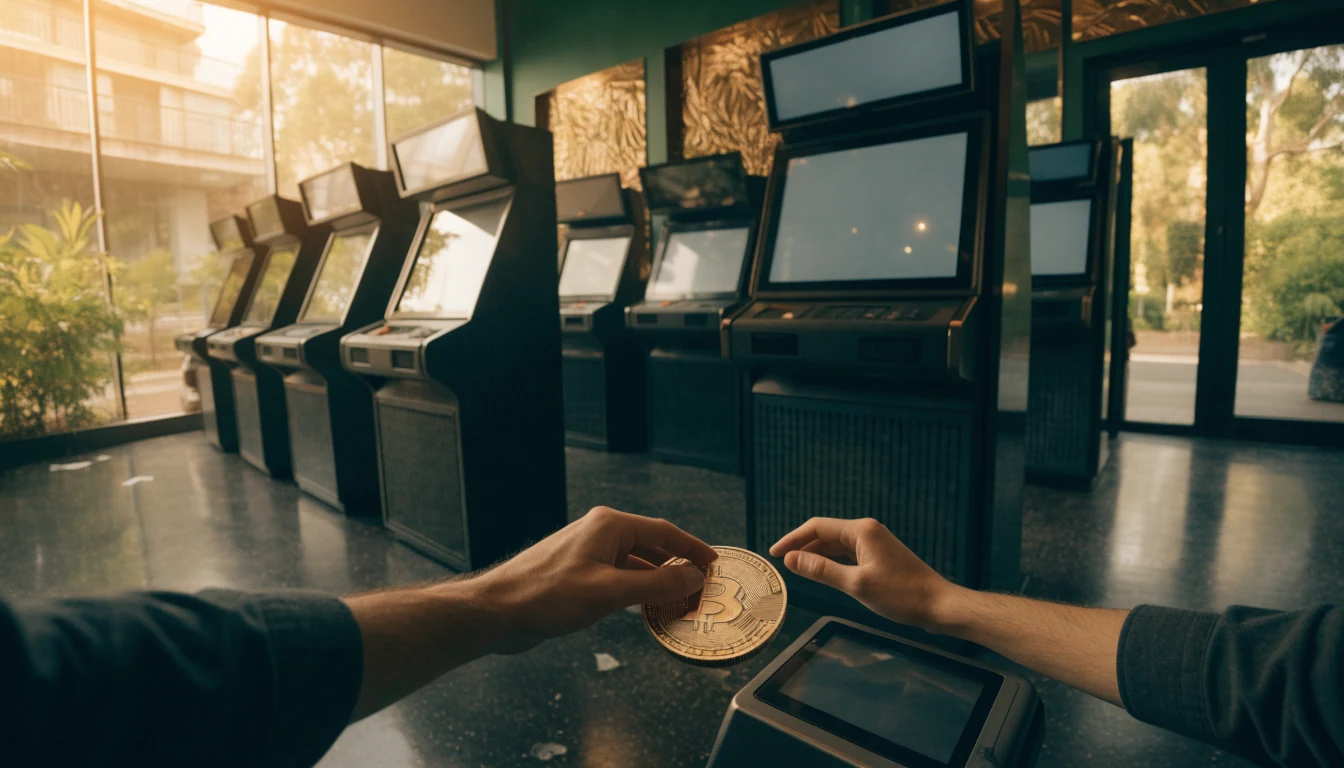
Bitcoin-paid pokies are digital slot machines that accept Bitcoin as a payment method. The underlying format is still a game presented on a screen: Bitcoin is associated with the money side of play, rather than changing what a slot machine is. The label describes a payment option, not a separate kind of game.
That distinction matters because promotional language can make the format sound more novel than it is. “Bitcoin pokies” may suggest that the games themselves run on Bitcoin. In practice, the description refers to pokies offered with Bitcoin as a way to fund real-money play. The game and the payment method are separate parts of the arrangement.
Online pokies can also be offered in free-play mode. In that mode, play uses no real-money stake; real-money mode involves wagering value. The visual experience may look similar, but the distinction is substantial: one is entertainment without a cash stake, while the other connects play to money. A familiar screen does not make the two modes equivalent.
I regard the mode label as more important than the payment branding. A page may foreground Bitcoin, but the basic question is whether play is free or involves real money. That is the point at which the format stops being merely a digital game and becomes gambling.
Free play is not a promise of later winnings, nor does it establish that a real-money version has the same terms. It is a different mode. Real-money play, in turn, should not be inferred merely because a game displays Bitcoin-related wording; the game’s own presentation needs to make clear what kind of play is taking place.
A separate point is how the game represents stakes. A specialist review describes game credits as specific to each game, with their Bitcoin value depending on the game and the current BTC price. That means a credit is not automatically a fixed Bitcoin amount that carries across every title.
The distinction can be easy to miss. A game may show a balance or stake in its own credits, while the value associated with those credits is expressed in Bitcoin. The displayed unit is therefore part of the game’s own system; it should not be read as a universal Bitcoin denomination. Credits in one game do not necessarily map directly to credits in another.
The Bitcoin price also changes over time. As a result, the Bitcoin value associated with a game’s credits can change even when the credit figure itself has not. A number on the game screen and its value in Bitcoin are not always the same kind of measure. One describes the game’s unit; the other depends on the conversion relationship at the time.
This is why a credit balance alone gives an incomplete account of value. The game-specific unit and the Bitcoin amount are related, but they are not interchangeable. Treating them as identical can make a displayed stake or balance seem more stable than its Bitcoin equivalent actually is.
The term identifies a combination: an online slot-style game, plus Bitcoin as a payment method for real-money play. It does not, by itself, establish how the game works, what its credits mean, or whether a particular screen is operating in free-play or real-money mode. Those are separate details.
Nor does the label mean that every game uses Bitcoin internally. The game may present its own credits, while Bitcoin is the payment method associated with the real-money account. The distinction is practical, not cosmetic: game credits describe play within a title, and Bitcoin describes value used for payment.
I have seen payment labels do too much work in casino copy. They make a familiar format sound like a new product. The mechanics are simpler. A digital pokies game is still a digital pokies game; Bitcoin is the payment layer, and the credit system belongs to the individual game.
This section is informational and does not invite or endorse real-money play. The page is affiliate material and may include sponsored links.
The legal boundary in Australia is not determined by whether a casino accepts Bitcoin, Australian dollars or another payment method. The relevant question is whether an operator provides real-money online casino games to people physically located in Australia. Under the Interactive Gambling Act 2001, that service is prohibited. Pokies sit within the same category as online poker and table games; changing the payment rail does not change the nature of the service.
That distinction is easy to blur in promotional copy. A site may be accessible from an Australian internet connection and may describe itself as accepting Australian players, but access is not the same as local authorisation. Australian law does not provide a licence for an online casino to offer real-money pokies to residents. There is no locally licensed online-casino market of the kind implied by phrases such as “Australian licensed casino.”
I have seen this distinction treated as a footnote when it should be the first line of the business model. The operator’s location, licence and payment options may tell something about how it runs its service; none of those details turns an offshore casino into an Australian-regulated one. A Bitcoin option changes how a payment is made, not which country’s gambling rules apply to the service.
The operators discussed in this market hold offshore licences, primarily from Curacao eGaming or the Anjouan Gaming Authority. Those licences are issued outside Australia. They do not amount to Australian approval, and the presence of a foreign regulator’s name on a site should not be read as local oversight. The important point is not whether a licence is mentioned, but where it comes from and what protections it can actually provide to someone in Australia.
This is where “licensed” can do more work in an advertisement than it does in practice. The word may be accurate in the narrow sense that an offshore authority has issued a licence. It does not mean that Australian consumer protection laws govern the operator, or that an Australian regulator is supervising the casino as a local service. Those are separate questions. In this case, Australian consumer protection laws do not apply to the offshore operators discussed.
That leaves a practical gap. If a dispute develops with an offshore business, the familiar domestic protections attached to Australian businesses and services cannot simply be assumed to apply. A foreign licence is not a substitute for those protections. Nor does a payment made in Bitcoin create a local complaint channel or a local regulator with authority over the operator. The consumer’s position is therefore materially different from dealing with a business operating under Australian consumer rules.
The gap matters because the service is presented in familiar terms: account, balance, game, withdrawal. The interface can look much like that of a domestic entertainment service, while the legal relationship sits elsewhere. In my experience, that is precisely where readers can overestimate what a licence badge means. It describes an operator’s offshore status, not a promise that Australian rules will resolve a dispute.
No Local Protection
Offshore operators are not regulated by Australian authorities, meaning domestic consumer protection laws do not apply to these services.
The law is directed at providers, not at creating a criminal offence for a person who plays at an offshore casino. The legal framework described here does not impose player liability for choosing to play. That should not be mistaken for approval, endorsement or a guarantee of recourse. The restriction remains on operators providing the prohibited service to people in Australia, and the lack of local consumer protection remains a separate practical concern.
There are also enforcement measures aimed at the providers. The Interactive Gambling Act sets a maximum daily penalty of AUD 360,000 for individuals and AUD 1.8 million for bodies corporate that violate it. Those figures describe the statutory exposure for responsible parties; they are not a measure of a player’s risk and should not be used to imply that an offshore service is safe or locally authorised.
For Bitcoin pokies in Australia, then, the country name in a site’s marketing does not establish that the service is Australian. It may refer to an audience the operator seeks, while the company and its licence remain offshore. The legal line is about the service being supplied to people in Australia, not the currency displayed on a payment page. No local casino licence is created by accepting Bitcoin.
This section is informational, not an invitation to use an offshore gambling service. The page is affiliate material and may include sponsored links; that commercial relationship does not alter the legal position or make any operator locally regulated. The distinction is worth keeping plain: offshore licence, not Australian licence; offshore service, not Australian consumer protection. No local cover.
Choosing a bitcoin pokies site in Australia means checking the details that matter before you play, including licensing, deposit minimums and payout information where available. This list provides a concise reference to the known facts for each operator.
Uptown Pokies
Uptown Pokies has operated since 2017 and lists a Curacao license. Its minimum deposit is A$20.
JustCasino
JustCasino lists a license from the Curacao Gaming Control Board.
WinSpirit Casino
WinSpirit Casino lists Curacao eGaming license OGL/2024/923/0383, issued through Antillephone N.V. Its minimum deposit is A$30.
MrPacho
MrPacho lists crypto payouts in 30–120 minutes and fiat payouts in 24–72 hours. Its minimum deposit is A$30.
Kingmaker
Kingmaker lists crypto payouts at around 90 minutes and fiat payouts in 1–5 days. Its minimum deposit is A$30.
DragonSlots Casino
DragonSlots Casino lists a Curacao Gaming Authority license, with Jumpman Gaming Ltd named in connection with it.
Thor Casino
Thor Casino lists a Curacao license through Antillephone N.V., with Versus Odds B.V. named in connection with it. Its minimum deposit is EUR 20.
Wild Tokyo
Wild Tokyo lists a Curacao license and crypto payouts in 30–60 minutes; fiat payouts are listed at 1–5 days. Its minimum deposit is A$10.
Neospin
Neospin lists Curacao Gaming Control Board license OGL/2023/176/0095, associated with Hollycorn N.V.
LuckyVibe
LuckyVibe lists Curacao Gaming Control Board license OGL/2023/176/0095, associated with Hollycorn N.V.
“Best” sounds like a verdict. In practice, it is a label built from criteria chosen by whoever is making the comparison. A review may weigh reputation, licensing and the range of pokies; another may give more space to interface design or payment options. Change the criteria and the ranking can change with them. The word does not, by itself, establish that an operator is safe, suitable or worth using.
I treat the label as a claim to examine, not a recommendation to repeat. That distinction matters in a market where an article can look like independent guidance while also carrying commercial links. This page is affiliate material and may include sponsored links. That disclosure helps explain the context; it does not turn a promotion into neutral advice or make an endorsement appropriate.
A review is more informative when it explains what it assessed and how it reached its judgement. A specialist review may recommend considering positive reviews, licensing and a varied pokies selection, but those headings need substance behind them. What does “positive” mean? Which aspects of licensing are being checked? Does “varied” describe a genuine difference in available games, or is it simply a broad label? If the explanation stops at attractive adjectives, the reader has been given a sales phrase, not a method.
Reviews also need to be read for their incentives. A comparison page can present itself as a guide and still earn money when a visitor follows a link. That does not automatically make every statement false. It does mean that the commercial relationship belongs in the reader’s assessment, alongside the criteria and evidence offered. A polished ranking is not proof of impartiality.
Licensing is another criterion that can sound more conclusive than it is. The useful question is not whether a page uses the word “licensed,” but what the claim refers to and what it can reasonably establish. A licence identifies a regulatory framework associated with an operator; it is not, by itself, a guarantee of fair treatment, dependable service or a particular outcome. A badge or a short line in a review cannot carry all those meanings at once.
Game selection is similarly a matter of fit, not a universal quality measure. A large catalogue may appeal to someone who values choice, while a smaller selection may be easier to assess. The number of titles alone does not establish their quality or tell anyone which one to prefer. Nor should a list of games be treated as evidence that an operator is “best.” It is one attribute, and its importance depends on what the person values.
The word “best” can also blur separate questions. An attractive interface, a broad selection and a favourable review are not interchangeable with evidence about how an operator handles its obligations. A comparison that combines unlike measures into a single score may be convenient to scan, but the score can hide trade-offs. The useful reading is often in the explanation beneath the rank: what was counted, what was left out, and whether the same standard was applied throughout.
I pay attention to the gap between a claim and its support. “Top-rated” should lead to an identifiable basis for the rating. “Trusted” should not be left as a mood. “Best choice” is a recommendation, even when surrounded by careful-looking tables. When the method is unclear, the ranking is best understood as the publisher’s presentation rather than an independent finding.
For Australian readers, there is an additional reason not to treat such language as permission or assurance. The content is for adults aged eighteen or over, and the presence of a comparison, review or commercial disclosure does not change what a reader should infer from it.
That is the practical meaning of the phrase “best online pokies bitcoin Australia”: it is not a category with a single objective winner. It is a promotional or editorial judgement whose value depends on the criteria, evidence and incentives behind it. Read the reasoning, not just the ranking. A label is easy to print. A defensible conclusion takes more.
Bitcoin pokies involve several separate layers that are easy to mistake for one balance: the currency itself, an account on a gambling site, and the credits displayed inside a particular game. Keeping those layers distinct matters. A figure shown in a game is not necessarily a direct reading of the amount of Bitcoin held in a wallet.
Bitcoin is acquired through a cryptocurrency exchange, where it can be purchased using government-issued currency. That is a separate service from a gambling account. An exchange account may require basic personal information and a password, and its own identity checks and security rules apply. A password should be unique to that service; reusing one across unrelated accounts makes a compromise harder to contain. These are ordinary account-security considerations, not a guarantee that a service or transaction is risk-free.
A Bitcoin wallet serves a different purpose from an exchange account. It is used to hold or manage Bitcoin, while the exchange is where a purchase can be made. The distinction is practical: access to an account does not mean the Bitcoin is represented as game credits, and a game-credit display does not replace a wallet balance. In my experience, confusion starts when interfaces make these separate systems look like one continuous account.
A gambling-site account is another layer again. Registration commonly asks for basic information and a secure password. The account provides access to the site’s own features, but it does not make Bitcoin and game credits interchangeable. A displayed balance can depend on the currency and rules used by that particular site or game. Treating every balance label as though it meant the same thing is a poor way to keep track of value.
For Australians, there is an important boundary around this subject: real-money online casino games are prohibited when offered to people physically located in Australia. This explanation is not an invitation or recommendation to open an offshore gambling account. The operators discussed in material of this kind are offshore, and Australian consumer protection laws do not apply to them. A foreign licence does not change that local legal position or provide the protections of an Australian-licensed casino.
There is also a commercial context to this page: it is affiliate material and may include sponsored links. That disclosure does not turn a gambling service into a recommendation, and it does not alter the legal limits applying in Australia. Real-money gambling is restricted to adults aged eighteen or over; the age condition does not make a prohibited service lawful.
Game credits are tied to the individual game rather than being a universal unit shared across all pokies. A specialist review describes their Bitcoin value as depending on the game and the prevailing Bitcoin price. That means a credit figure needs context: the same number of credits in two different games should not be assumed to represent the same Bitcoin value, and the Bitcoin equivalent can change as the market price changes.
This distinction affects how a balance is read. A game may show credits rather than a Bitcoin amount, while a site or wallet may display Bitcoin separately. The conversion between those displays is not necessarily fixed. A player looking only at the credit count can miss what it represents in Bitcoin terms; a Bitcoin figure, in turn, does not tell the whole story about how a game expresses its stakes or results.
The price relationship also means the displayed Bitcoin equivalent is not a stable measure of value over time. A change in Bitcoin’s market price can alter the equivalent value of a credit balance even when the number of credits has not changed. Conversely, moving between games may change the credit denomination or scale. The figures on screen need to be read as part of that game’s own system, not as a universal currency conversion.
When I reviewed account flows, the point that mattered was not the number of labels on the screen but whether each label clearly identified what it measured. Bitcoin, account balance and game credits answer different questions. If the interface does not make that distinction plain, the apparent simplicity is cosmetic. Keep the units separate.
A Bitcoin transfer has two separate parts: the movement of funds across the network and the operator’s handling of the payment request. The blockchain can record a transaction without the casino having credited a deposit, just as an operator can approve a withdrawal before the funds reach the wallet. Treating these as one event is where much of the confusion starts.
For a deposit, the operator provides an account address. The sender copies that address into their wallet, enters the amount and confirms the transfer. The address is the destination, so accuracy matters more than speed. Bitcoin transactions cannot generally be reversed once sent; funds sent to an incorrect address are usually unrecoverable. A pasted address should be checked against the one displayed for that payment, rather than trusted simply because it looks familiar.
A deposit can fail to appear in the account for reasons that do not mean the transaction has vanished. An address may have been reused, the amount sent may have been below what the operator expected, or the operator may not yet have detected the incoming payment. These are different problems. The blockchain record concerns what was sent and where; the account balance depends on the operator matching that record to its own payment process.
That distinction matters when investigating a missing credit. The transaction details in the sending wallet can establish whether a transfer was made and which destination was used. If the destination is correct, the next question is whether the amount met the displayed requirement and whether the operator has recognised the deposit. Sending another payment before resolving the first can compound the problem, especially if the original transfer was simply awaiting detection.
Bitcoin transfers incur a miner’s fee, which is separate from any charge an operator may apply. The fee is associated with processing a transaction on the network and varies over time. A specialist review characterises this network fee as “usually minuscule”; that is a description from that type of source, not a fixed price or a guarantee about what any individual transfer will cost.
The wallet presents the fee before confirmation, so it should be read as part of the transaction rather than assumed to be included in the amount going to the destination. The operator’s credit and the wallet’s network charge are not the same line item. If a payment is short of the amount the operator expects, a fee deducted from the sent amount may be relevant, depending on how the wallet and payment form calculate the transfer.
There is no useful universal fee figure: network conditions change, and a fee observed at one moment may not describe a later transaction. The practical point is to inspect the final wallet summary, including the destination amount and fee, before approving the transfer. Once broadcast, a mistaken transaction cannot generally be recalled.
A Bitcoin withdrawal begins on the operator’s side, not the blockchain. The account holder enters a wallet address in the casino’s withdrawal form and submits the request. The operator must process that request and send the funds; only then is there a network transaction to follow. A pending request is therefore not the same as a transaction already broadcast to the blockchain.
Address accuracy remains critical at the withdrawal stage. A copied wallet address should be checked before submission, because a transfer to the wrong destination is generally irreversible. The account form may show the requested amount, while the wallet later shows the amount received and any network fee. Those figures can differ if a charge is deducted from the outgoing transfer.
A specialist review reports that most Bitcoin withdrawals are completed within an hour. That is a source-specific description, not a dependable service standard for every operator or request. The operator may first hold the request in an approval queue, and business-hours batch processing can add time before anything reaches the network. A withdrawal can also be delayed when the operator has not completed its own processing, even though Bitcoin itself is not experiencing a problem.
Once a transaction has been broadcast, the transaction record helps distinguish network movement from an operator-side delay. Before broadcast, the relevant status is still the operator’s request. This difference is easy to miss when a balance has changed but the destination wallet shows no incoming transfer. A balance adjustment alone does not establish that funds have been sent.
For a deposit that has not appeared, compare the destination address and amount in the wallet with the payment details shown by the operator. Then establish whether the operator has detected the payment. Address reuse, underpayment and delayed detection are known explanations; none can be diagnosed merely from the absence of a credit on screen.
For a withdrawal, first distinguish a request awaiting approval from a transaction already sent. If the operator has issued a transaction, its blockchain record is the relevant evidence of movement. If no transaction has been issued, the delay remains within the operator’s process. Network fees do not explain every delay, and a slow account update does not by itself prove that a transfer is lost.
The mechanics are simple in outline: copy the casino-provided address to deposit, and copy the wallet address into the withdrawal form to request payment. The risk sits in the handoff between those steps, the wallet and the operator’s accounting. Check the destination. Keep the transaction record. Once funds leave for the wrong address, there is generally no reversal mechanism.
A withdrawal request can turn an account that appeared settled into a review case. The delay is not always caused by the Bitcoin transaction itself. Operator-side approval queues, identity checks that remain incomplete, and batch processing restricted to business hours can all hold up a payout. From the counter, these stages looked similar to the player: the request was submitted, but the balance had not moved. The cause matters, because waiting for an approval is different from answering a verification request.
Verification is often staged. Basic registration details may be accepted first, with identity and address documents requested later. Stage-two checks can be triggered at a first withdrawal or after cumulative deposits reach AUD 2,000–5,000, depending on the operator. That range is not a universal threshold; the trigger is set by the operator. A request arriving at the payout stage can therefore feel sudden even when the account has been active for some time.
Completing requested checks before a withdrawal is pending can reduce one avoidable source of delay. It does not guarantee approval or a particular processing time. I have seen the operational distinction: a file that is ready to review can enter the queue, while a file missing documents cannot. The practical benefit is limited but real. Fewer unanswered questions.
Crypto can add a separate ownership check. A specialist review describes operators asking for a message signed from the deposit address or a wallet screenshot showing the sending transaction. These are ways to connect an account to the wallet activity under review, not proof that every operator uses the same procedure. A screenshot should show only what the operator requests; wallet credentials and recovery phrases are not evidence to disclose.
There is also a difference between a review and a refusal. A security review may be justified by account checks, but some operators may use reviews after significant wins as a stalling tactic, particularly for a new account or a first large withdrawal. That possibility does not establish the reason in any individual case. The useful record is factual: dates of requests, copies of submitted documents, the operator’s stated reason for the hold, and any changes to the case status. Keep communications in the operator’s official channel and avoid sending extra personal or wallet information that was not requested.
Bonus disputes often begin with wording that appears simple until a game is counted. A contribution percentage determines how play on a particular game affects wagering requirements. Terms may assign 0% to table games and 100% to pokies, while some high-RTP slots may be capped at 50%. Those differences can make the displayed progress diverge from what a player expected. The label “eligible games” is not enough on its own; the contribution rules and exclusions determine what counts.
Maximum bet rules create another common fault line. Bonus play may be voided if a player exceeds the stated maximum bet. In a dispute, the operator may rely on the logged bet history rather than a player’s recollection of the session. I have watched a small-looking condition become decisive because it was enforced against the whole bonus balance. The question is not merely whether the game was allowed, but whether the stake stayed within the condition while bonus funds were active.
A complaint is stronger when it separates issues: verification still pending, a security review with no clear explanation, or a bonus calculation that conflicts with the published contribution table. Screenshots and dated correspondence help establish what was displayed and when. They do not compel an offshore operator to resolve a dispute in the player’s favour. Australian consumer protection laws do not apply to the offshore operators discussed here, so the familiar local protections cannot be assumed.
One response should be treated as a warning sign: a request to deposit more money to release a stuck withdrawal. Sending additional funds does not resolve an existing verification or approval hold. It can increase the amount exposed without changing the reason the payout is pending. No extra deposit.
Verification may be requested at the first withdrawal or once cumulative deposits reach AUD 2,000–5,000, depending on the operator. Crypto checks may also require signing a message from the deposit address or showing the sending transaction in your wallet.
Free-play pokies do not involve a real-money stake. Real-money online casino games, including pokies, are prohibited from being offered to people in Australia; using Bitcoin does not change that.
Bonus terms can set a maximum bet, and exceeding it may void bonus play. Wagering contributions also differ by game: table games may contribute 0%, pokies 100%, and some high-RTP slots may be capped at 50%.