Poker, rooms, dining, parking and other popular searches are separated from details the available information does not confirm.
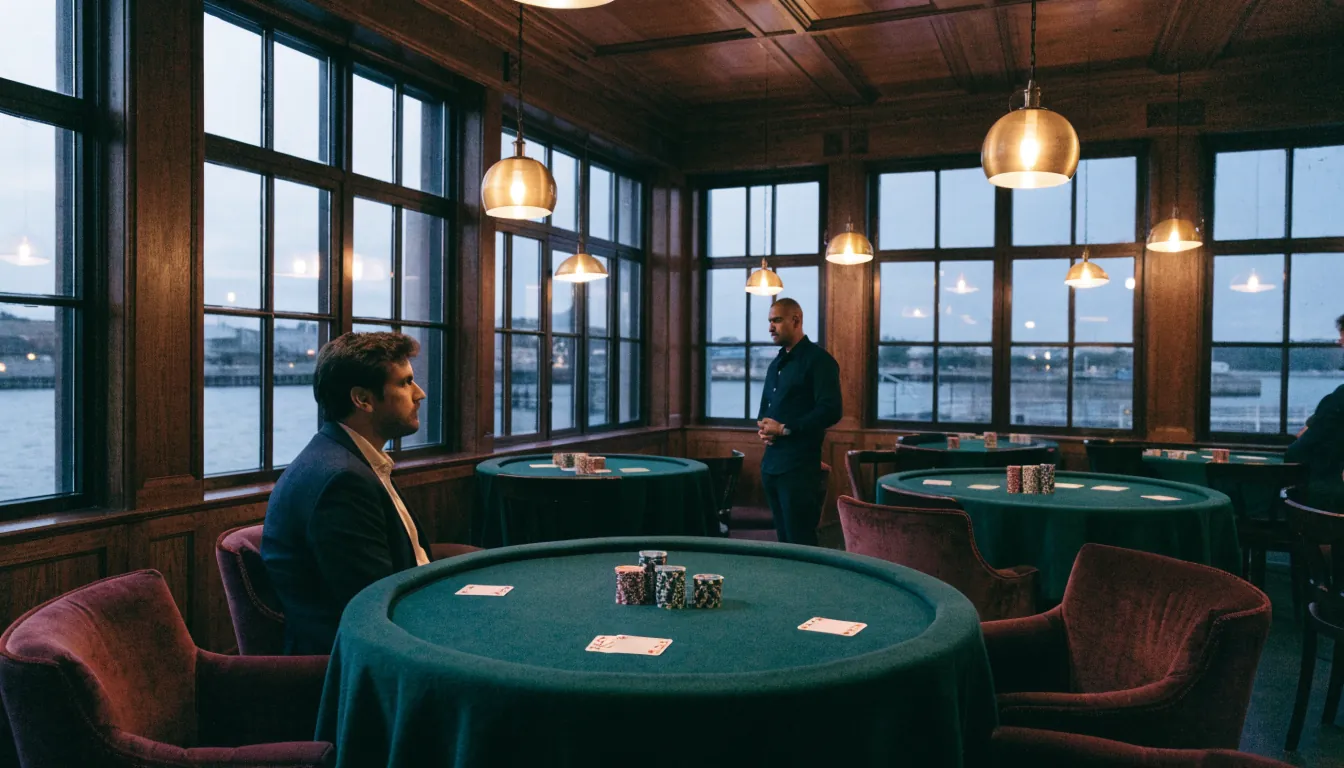
A search for poker in Hobart can point towards several different things: a dedicated poker room, a table-game area, a scheduled tournament, or simply poker-related activity at a casino. Those are not interchangeable. A venue’s general casino status does not, by itself, establish that it runs poker or has a separate room for it.
I treat “poker room” as a specific claim, not a loose label. It suggests a place where poker is organised and played, with defined arrangements for games or events. A tournament is more specific again: it needs a format, registration details, entry conditions and a date. Without those particulars, the word “tournament” is not enough to plan around. The distinction matters. A regular cash game and a one-off competition may share a table, but they do not have the same structure or schedule.
The same care applies to references to casino rooms. In a poker context, that phrase might mean a room where poker is played; elsewhere, it can mean accommodation. Search wording alone does not settle the meaning. For a poker visit, the useful confirmation is an official venue description that clearly identifies poker, rather than a general page about casino facilities.
Choosing an online casino while in Hobart means checking the details available for each option before deciding what suits you. This list provides a concise reference to the operators and the information provided about them.
Uptown Pokies
Uptown Pokies has operated since 2017 and lists a Curacao license. Its minimum deposit is A$20.
JustCasino
JustCasino lists a license from the Curacao Gaming Control Board.
WinSpirit Casino
WinSpirit Casino lists Curacao eGaming license OGL/2024/923/0383, issued through Antillephone N.V. Its minimum deposit is A$30.
MrPacho
MrPacho lists crypto payouts in 30–120 minutes and fiat payouts in 24–72 hours. Its minimum deposit is A$30.
Kingmaker
Kingmaker lists crypto payouts in about 90 minutes and fiat payouts in 1–5 days. Its minimum deposit is A$30.
DragonSlots Casino
DragonSlots Casino lists a Curacao Gaming Authority license, with Jumpman Gaming Ltd named in connection with it.
Thor Casino
Thor Casino lists a Curacao license through Antillephone N.V., with Versus Odds B.V. named in connection with it. Its minimum deposit is EUR 20.
Wild Tokyo
Wild Tokyo lists a Curacao license and crypto payouts in 30–60 minutes, with fiat payouts in 1–5 days. Its minimum deposit is A$10.
Neospin
Neospin lists Curacao Gaming Control Board license OGL/2023/176/0095, with Hollycorn N.V. named in connection with it.
LuckyVibe
LuckyVibe lists Curacao Gaming Control Board license OGL/2023/176/0095, with Hollycorn N.V. named in connection with it.
When a venue publishes poker information, the practical details usually answer separate questions. Is the game cash poker or a tournament? Is the session scheduled for a particular date, or described as recurring? How is registration handled, and are there entry conditions? Are changes or cancellations announced through the same official channel? These details should be considered together, because an event title without a current date does not confirm that play is taking place.
I have seen how a short promotional label can do more work than its detail supports. “Poker night” sounds definite; the useful part is the event information attached to it. No calendar, no plan. A listing may also be old, or may describe a past event rather than an ongoing offering. The date and current status are what turn a headline into something operational.
For a search about poker at a Hobart casino, the sound approach is to separate what the venue itself states from what a directory, visitor comment or copied event listing says. Third-party pages can be useful pointers, but they can retain old schedules or blur a one-off event into a regular service. A current official notice is stronger evidence of what is available on a particular day.
The word “poker” can also create confusion on a casino floor. Poker as a card game is different from pokies, the electronic gaming machines commonly found in Australian venues. A page mentioning gaming facilities or Electronic Gaming Machines (EGMs) does not confirm that live poker is offered. Nor does the presence of a casino table-game area establish that poker is among the games available.
Online poker is a separate matter. The Interactive Gambling Act 2001 makes it illegal for operators to provide real-money online poker to people physically located in Australia. That legal distinction does not describe a live, in-person game at a venue; it does mean that an online poker service should not be treated as a substitute for a local room or tournament.
Opening status is another separate check. A casino being open does not necessarily mean that poker is running at that time. Poker can have its own schedule and conditions, so a general “open today” indication should not be read as confirmation of a game or event. The relevant information is the current poker listing, if one is published, rather than the venue’s general operating status.
The practical conclusion is narrow: a poker room, a scheduled tournament and a casino’s general opening status each need their own confirmation. Keeping those claims separate avoids treating a search label as a promise of a particular game. For Hobart, the phrase “best casino” cannot settle the poker question; the value is in current, specific venue information, not in a broad ranking or an assumed schedule.
Accommodation planning around a casino is often framed as a single purchase: book a room, then expect the venue to supply the rest. In practice, these are separate decisions. A place to stay may be independently operated, while a casino promotion may have its own eligibility rules and booking conditions. I keep those offers apart until the details show they are genuinely connected.
“Near” is not a useful measure on its own. A property can appear close on a map yet involve an inconvenient route, while a stay farther away may suit a particular arrival plan better. I compare the route to the venue, not just the straight-line distance, and consider how the journey will be made. Those details matter more than a broad label suggesting that accommodation is associated with a casino.
A sensible comparison starts with the actual booking terms. The nightly rate is only one part of the decision: cancellation rules, payment timing, included services and any restrictions can change the value of an offer. The same applies to a promotion described as a casino accommodation deal. The wording should explain what is included, who can claim it, how the booking must be made and whether venue activity is required. A headline discount is not the same thing as a confirmed saving.
I have seen promotional language do a lot of work before the conditions are read. “Exclusive” may mean that an offer is available through one booking channel, not that it is better than other rates. “Package” can bundle services that would not otherwise be chosen. The practical question is whether each component is useful and whether the full terms match the advertised description. Fine print matters.
For a stay near a Hobart casino, the comparison should therefore be between specific accommodation options and a clearly defined venue destination—not between vague labels. The venue’s location needs to be established before travel time or proximity can be judged. Then the route can be checked against the property’s own address and the intended mode of transport. No shortcut. A map pin is not a travel plan.
Casino promotions also need to be distinguished from accommodation discounts. A gaming offer, where one is advertised, does not automatically reduce the cost of a room. Nor does a room booking necessarily include access to a promotion. Eligibility, booking channel and exclusions can all affect the result. I would treat each claim as a separate term to verify rather than assuming that two services are linked because they appear together in an advertisement.
Searches for Hobart casino accommodation deals often imply that a standing package exists. That should not be taken for granted. Offers can change, end or apply only under particular conditions. A current price and its terms need to be checked at the point of booking; an old mention or a copied listing can outlive the offer it describes.
The same discipline applies to the venue location and surrounding logistics. Accommodation decisions depend on where the destination is, how the route works and whether the arrangement suits the trip. Those are concrete checks, not marketing claims. I would not attach a travel time, property name or package benefit to the casino without a dependable basis for doing so.
The useful distinction is simple: choose a place to stay on its own merits, then assess any casino-linked promotion as a separate offer. If the terms do not clearly connect the two, they are not one deal. No assumptions.
A search for a casino hotel in Hobart can blur two different questions: whether a particular property is a hotel, and whether its rooms are part of a casino stay. The wording of a listing may make the connection sound straightforward, but it does not establish who operates the accommodation, how it relates to the venue, or what a booking includes. I separate those claims before treating a room as a casino hotel room.
The practical check is the property’s own current information. It should identify the accommodation provider, give the property’s address, and explain whether a casino visit is included, merely nearby, or not part of the offer at all. A shared name or a search result appearing beside casino information is not enough to establish a formal connection. Marketing language can compress several separate services into one attractive phrase.
Room details need the same care. A listing should specify the room category actually being booked, the included facilities, any accessibility information, and the terms that apply to the reservation. Those details belong to the individual property and booking conditions; they should not be inferred from the word “hotel” or from a photograph. If a room description is incomplete or differs between a booking page and the property’s own site, the discrepancy matters more than the headline.
Rates are also property- and date-specific. A displayed price may depend on the selected dates, room availability, cancellation terms, and what the quoted rate includes. A package may use “casino stay” as a promotional label without explaining whether admission, dining, or any other service is included. I would treat each element as a separate condition, not as an automatic benefit of booking a room. Fine print is part of the product.
The phrase “near the casino” needs a measurable basis. A map location can help establish where a property sits, but it does not by itself confirm walking access, transport arrangements, or a relationship between the hotel and venue. Those are distinct claims. Where location matters, the property address and a route checked against a current map are more useful than a broad label in a listing.
Searches for Hobart casino hours or shows do not settle hotel questions either. Venue opening times and entertainment schedules are separate from room availability and hotel services, and one should not be used to infer the other. A stay listing that promises an experience should state its inclusions and applicable conditions; the promise alone is not a schedule.
I have seen how a compact headline can carry more certainty than the details beneath it. “Casino hotel” sounds like a single, defined product. In practice, the booking terms have to show what is actually connected: the property, the room, the venue, and any stated extras. Without that link spelled out, the safest description is simply the accommodation that the named property itself confirms. No assumed package.
Parking, bingo and dining are separate practical questions, even when they are grouped under a visit to a casino. A venue name alone does not establish that a particular service is available. I have seen how easily a listing turns an assumption into a promise: “free parking” sounds definite, while the conditions that matter—availability, access and any charge—are left unstated. The same caution applies to valet parking. Neither should be treated as confirmed without current information from the venue.
That distinction matters when planning arrival. A parking arrangement can affect the route and timing of a visit, but a general reference to a casino does not tell us whether on-site spaces, complimentary parking or valet service are provided. Those details should be checked directly before relying on them. No implied offer. No assumed facility.
Legal Restriction
The Interactive Gambling Act 2001 makes it illegal for operators to provide real-money online poker and casino games to people physically located in Australia.
Bingo is another service that should be verified separately. A casino search does not establish that bingo is held there, or that a session is available on a particular day. The word can refer to a specific organised activity, not a general feature of gambling venues. Any claim about its availability, format or schedule needs current confirmation rather than inference from the venue category.
Dining calls for the same discipline. A casino may be associated with food in a visitor’s mind, but that does not confirm a dining service at a particular site or establish its current arrangements. For a Hobart visit, distinguish between a confirmed venue service and a general expectation. “Dining” is not a menu, an opening time or proof that a particular option is operating.
The online-casino question is different because it has a legal answer, not just a venue-information answer. The Interactive Gambling Act prohibits Australian-based operators from providing real-money online casino games to people in Australia. That restriction covers games such as pokies, blackjack and roulette. A physical casino in Hobart should not be presented as proof that it offers a lawful online casino service to local players.
Offshore platforms sit outside Australian regulation, although Australian players are not generally criminalised simply for using them. That does not make those services Australian-licensed or protected under Australian law. The distinction is easy to blur in promotional copy: “available online” can sound like a local service, when the operator may be offshore and the legal protections are not the same. The operator’s position matters.
Access can also be restricted by location. A site or game may use an IP address to identify a player’s country and block access accordingly. A specialist review has reported that some providers have restricted games for Australian users, but such policies can change. Using a VPN to get around a regional block may breach the site’s terms and can lead to account suspension. It is not a reliable route to access.
For a Hobart visit, parking, bingo and dining need venue-specific confirmation. Online casino play is not simply another amenity attached to the address; Australian law draws a clear line around what operators may provide. Keep those questions separate. Different rules apply.
Contact details are useful only when they lead to the right department. A general reception line may handle basic enquiries, while questions about gaming tables, events or parking may need to go elsewhere. I treat a phone number copied into an old directory or social post as a lead, not confirmation. Before travelling, use the venue’s own current contact channel and check that the details relate to the Hobart property rather than another business with a similar name.
The same rule applies to a map. A pin can mark a broad site entrance rather than the door a visitor needs, and a route that looks straightforward on a screen may not answer where to enter or where vehicles can stop. Check the venue’s current directions and any arrival instructions before setting out. If a map service and the venue’s own directions differ, the venue’s instructions are the sensible reference.
Searches about a casino car park are often really about the last part of the journey: whether parking is available, which entrance serves it, and whether access arrangements change during an event. Those details should be confirmed directly rather than inferred from a map marker or an old visitor comment. I have seen small assumptions create the biggest delays. Wrong entrance.
For anyone arriving by car, it is worth checking whether parking is available to general visitors and whether any conditions apply on the planned visit. Do not assume that a car park shown near a venue belongs to it or is available to casino guests. If travelling by taxi or rideshare, confirm the appropriate drop-off point through current venue directions; a convenient-looking entrance may not be the one intended for arrivals.
A bar listing is not a promise that a bar is open at a particular time, or that it will be accessible during every event. Confirm the current venue information before making plans around drinks or meeting someone there. Concert information can change too: a listing should be checked for the event date, ticketing arrangements and any entry conditions, rather than treated as a standing entertainment schedule.
The same care matters with baccarat and craps. A search for either game does not confirm that a table is operating, that a particular format is offered, or that play will be available during a specific visit. Table-game availability can be a separate operational question from whether a venue has gaming facilities at all. I would check directly for the game, session timing and any entry requirements instead of relying on a broad description.
“Entertainment” is an attractive umbrella term; operationally, it can cover very different things. A concert, a bar visit and a table-game enquiry may each have a different contact route or set of conditions. Keep the question specific when contacting the venue, and ask for the detail that affects the visit: where to arrive, whether the service is operating, and what arrangements apply that day. That is more useful than treating a map pin, an old listing or a general promotional phrase as a complete plan.
Breakfast and buffet searches often combine several assumptions: that food is served at the casino, that a buffet is operating, and that breakfast is included in a particular visit or stay. Those are separate points, not one offer. I would not read the word “buffet” in a listing as proof of a current service. The practical check is whether the venue itself identifies the meal, service period, location and any conditions attached to it. Without those details, a search result is not a booking basis.
The same caution applies to a casino described as a “resort”. It is a broad promotional label, not a reliable inventory of facilities. In my experience, the label can lead people to expect a package of services that has not actually been specified. The useful question is what is available at the venue now, and whether access is open to visitors or tied to another booking. Keep that separate from accommodation planning; the word alone does not establish what rooms or guest services exist.
Rewards programs need a closer read than their headline benefit suggests. A name or sign-up invitation does not explain who can join, what earns recognition, whether benefits are restricted, or how the conditions can change. Before treating a reward as part of a visit, look for the operator’s own current terms and confirm that the program applies at the Hobart venue. “Exclusive” is a marketing word; the conditions decide who qualifies. Small print matters.
A useful check is to confirm that the terms identify the responsible operator, describe eligibility plainly and explain how a benefit is claimed. If the offer appears only in an old listing or an undated post, it may describe a past arrangement rather than one currently available. Keep a copy of the terms shown when making a booking or enrolment. That gives a clear reference if the offer later appears differently.
Employment searches require a different kind of verification. A listing should identify the employer, the actual workplace, the position and how applications are submitted. A role connected with a casino may be advertised by a contractor rather than the venue, so the employer name matters. Check whether the advertisement is current on the employer’s own careers page before sharing personal information. A familiar venue name in a job title is not, by itself, proof that the venue is hiring.
I separate these searches into three decisions: what food service is actually stated, what a rewards offer requires, and who is responsible for a job vacancy. That prevents a buffet phrase from being mistaken for a meal arrangement, a rewards headline from being treated as guaranteed value, or a third-party vacancy from being confused with direct employment. Each claim needs its own confirmation. No assumptions.
A venue’s trading status, published hours and event calendar are separate pieces of information. A page describing the casino as open does not, by itself, establish that every part of the venue is operating or that an event is still scheduled. I treat each claim as time-sensitive and look for a current notice from the venue before relying on it. Old listings can remain visible after arrangements change. That is the practical distinction.
The same caution applies to searches about whether the casino has reopened. “Reopened” may refer to a particular area, service or period rather than the whole venue. Without a current, specific announcement, the word is not enough to establish what is operating now. Hours copied into directories can also lag behind changes, so a listing without a recent date should not be treated as confirmation.
An event listing needs more than a title. It should identify the date and location and indicate whether the booking or programme is current. A past concert announcement may continue to circulate, while a general entertainment page may describe a recurring offering without confirming its next appearance. I separate an announced event from a general description: only the first can establish a particular programme, and only while its details remain current.
A review is different again. Reviews can describe an earlier visit, but they are not a live status report. They may help explain a visitor’s impression; they cannot settle today’s opening hours, event schedule or operational arrangements. The date and scope matter. Old evidence is not current evidence.
A reference to casino development could mean a proposal, construction activity, a planning process or a completed change. Those stages should not be collapsed into a claim that a project is under way. The wording of an announcement matters: a proposal is not approval, and approval is not proof of completion. In the absence of a dated, attributable update, a development claim remains unresolved.
Employment information is similarly time-dependent. A general careers page does not establish that a particular role is available, and an old vacancy may no longer be open. Any specific opportunity needs a current listing and clear terms from the relevant employer. I would not infer hiring activity from a development rumour or an event announcement. Different evidence, different claim.
Menu references can also become stale, even when they appear alongside event information. A menu listing does not confirm that the associated service is operating at the time of a visit. Its date and connection to the venue need to be clear.
For anyone assessing the Hobart casino in 2026, the sound approach is to distinguish enduring descriptions from current operational statements. Hours, reopening notices, events, development updates and vacancies each require their own recent confirmation. Where that confirmation is absent, the responsible account is not to fill the gap with a plausible schedule or announcement.
A request for the Hobart casino’s address sounds straightforward, but a name in a search result is not enough to plan a visit. Venue names, entrances and listed contact details can be presented differently across directories. I would confirm the address against the venue’s own current visitor information before setting out, then check that the map pin corresponds to the public entrance rather than a nearby building or service access. A wrong pin can turn a simple arrival into a nuisance.
The same distinction matters for a spa. A search for a casino day spa does not establish that spa services are on site, that they are open to day visitors or that appointments are available. Those are separate details, and an old directory entry can outlive the service it describes. Until a current venue listing confirms what is offered and how access works, it is safer to treat the spa as unconfirmed—not as part of the casino visit.
Dress-code information also needs context. A rule may apply to a particular room, bar or event rather than to the entire property. “Smart casual” is one of those polished phrases that can conceal the practical question: what clothing will actually be refused at the door? I would look for the venue’s own current entry conditions, especially if the plan includes more than one area. If no specific policy is published, there is no sound basis for presenting a precise rule as fact. Check first. Avoid surprises.
Bars raise a similar issue. A directory may name a bar without showing whether it remains open, whether it is accessible to general visitors or whether its service is limited to particular hours or occasions. Those distinctions affect the visit more than a venue label does. Confirm the current listing and any access conditions directly; do not assume that a casino address automatically means every advertised facility is operating there.
Career searches belong in a different practical category. A search result or old vacancy is not evidence of an active role, and job titles do not establish current hiring. Applications should be based on live vacancies published through the venue’s own recruitment channel, with the role, location and application route checked before personal information is submitted. No active position should be inferred from a general careers page.
Finally, “casino games” can mean several things: a venue’s games, an event activity, or online play. Those are not interchangeable. The Interactive Gambling Act 2001 prohibits operators from providing real-money online casino games, including slots and table games, to people in Australia. A physical venue search does not change that legal boundary. Keep the distinction clear.
A restaurant associated with a casino can mean several different things: a dining room inside the venue, a separately operated business on the same site, or a nearby restaurant included in a travel listing. Those distinctions matter. A result labelled as a Hobart casino restaurant does not, by itself, establish where the restaurant is, who operates it or whether it is currently serving guests.
I would treat restaurant names, menus and service details as things to confirm rather than fill in from expectation. Casino venues can change their food offering, and an old listing may remain visible after a restaurant has closed or changed format. The useful checks are concrete: does the venue itself identify the restaurant, is the listing current, and does it describe a dining service rather than a function space or a bar? Without that chain, a polished menu page can still be out of date.
The same caution applies to claims about restaurants “at” or “near” the casino. “At” implies a connection with the venue; “near” may describe an independent business with no casino affiliation. A map pin or search result is not enough to settle that difference. I would look for the restaurant’s own current information and compare it with the venue’s material before treating the relationship as established.
A rooftop bar is a separate question, even when it appears alongside restaurant listings. The label does not confirm that food is served, that the space is open to the public, or that it belongs to the casino. Nor does a rooftop dining photograph establish current access or service. The distinction is practical: a bar listing cannot stand in for a restaurant, and a restaurant listing cannot confirm a rooftop facility.
For anyone comparing a casino in Hobart, Australia, on dining alone, the reliable decision points are the current restaurant identity, the operator, the type of service and the venue’s own statement of availability. Menus and opening times should be checked close to a planned visit; neither should be inferred from an archived page or a third-party directory. If a listing offers no current confirmation, it is safer to regard the detail as unresolved than to build a meal plan around it.
That is the unglamorous part of venue research. A name is not a service.
Food and pool searches point to two different expectations: somewhere to eat during a visit, and a place to swim or spend time around the water. Neither expectation establishes that a particular facility is part of a Hobart casino. A search result can combine words because people are looking for a convenient package; it is not evidence that the venue provides one.
I have seen “food court” used loosely in venue descriptions. It can suggest several quick-service choices grouped together, but the phrase alone does not confirm a food court, its operators, or even whether food is sold on site. It should not be treated as a substitute for current venue information. A nearby place to eat and an in-venue food court are not the same arrangement.
The same distinction applies to a pool. A result associating a casino in Hobart with a pool does not establish that the casino has one, that access is included with a visit, or that the facility is open to non-guests. Those details matter because a pool may belong to a separate property or service rather than the casino itself.
I would separate the practical checks. For food, confirm whether any on-site service exists and what kind of service it is; for a pool, establish its location, access conditions and operating status with the relevant venue. Those are different questions, and broad labels do not answer them.
No assumptions. Just confirmation.
You must be at least 18 to play poker machines in NSW.
Online pokies use a Random Number Generator, so each spin is independent and previous results do not affect the next one. RTP describes the theoretical share of wagers a game returns over a very large number of spins.
Region blocking uses your IP address to identify your location and restrict access to games or providers in certain countries. Blocked games may not appear in the lobby or may fail to load.
Yes. The Interactive Gambling Act restricts Australia-based operators from offering online casino games such as pokies, blackjack and roulette to people in Australia. Offshore sites may be accessible, but they are not regulated under Australian law.
It is illegal for an Australian-run online casino to offer its services to players in Australia, while it is technically not illegal for Australian players to use offshore platforms; those platforms are not regulated under Australian law. In NSW, you must be 18 to play poker machines, and mandatory pre-commitment requires players to set a loss limit before playing.