
FreshBet account, KYC and support
 Available in US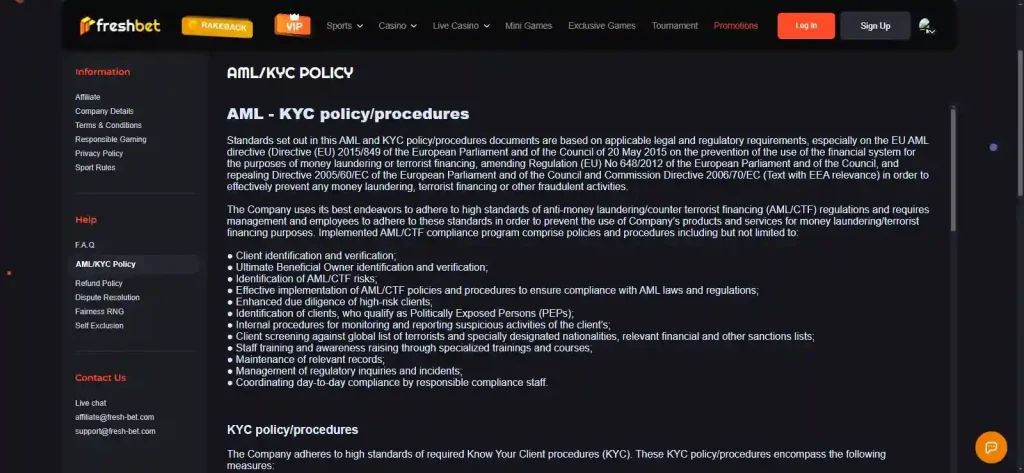
FreshBet uses identity checks around financial activity, pairs the account with live chat and email support, and includes self-exclusion, time-out and self-assessment controls. The practical account experience therefore has four moving parts: getting help when something stalls, using safer-gambling controls when needed, accessing the service from a mobile browser, and preparing the identification material that can be requested before transactions.
Table of Contents
- Support channels cover chat and email
- Self-exclusion, time-out and self-assessment serve different roles
- Mobile access runs through the browser
- Identity checks can precede financial transactions
- Common questions about the FreshBet account
- FreshBet account access centres on identity checks and account controls
Support channels cover chat and email
Live chat is available on FreshBet, which makes it the most direct support route for an account question that needs back-and-forth conversation. AskGamblers lists that chat as operating 24/7. FreshBet also lists [email protected] as its support email, giving users a written channel that is useful when a query involves several documents, a timeline of events, or details that are easier to explain in one message.
The two channels suit different kinds of friction. Chat is better for checking what the next step is, clarifying which part of a process is holding up an action, or asking which document category is needed. Email is better for keeping a complete written trail, especially when multiple attachments or a longer explanation may be involved. Neither channel changes the underlying KYC requirements, so a support conversation should be treated as a way to resolve process questions rather than a substitute for the information the account team requests.
- Live chat: useful for immediate account navigation and short clarification questions.
- Email: FreshBet lists [email protected] for written account support.
- Verification context: financial activity can trigger identity checks, so support and KYC often intersect around deposits and withdrawals.
For transaction-specific mechanics, the broader payment methods guide separates funding rails and currencies from account verification. Cashout timing and verification friction are covered separately in the withdrawal guide, which keeps the account discussion here focused on access and identity rather than payment-speed claims.
Self-exclusion, time-out and self-assessment serve different roles
FreshBet includes a self-exclusion section, while time-out and self-assessment controls are also listed for the account. They address different levels of intervention. A self-assessment tool helps a person reflect on patterns of play. A time-out introduces a temporary break. Self-exclusion is the stronger account-control option when a longer separation from gambling is needed.
That distinction matters because safer-gambling controls are most useful when the user understands what each one is designed to do. A short pause is not the same thing as a longer account exclusion, and a questionnaire does not itself restrict access. Treating them as separate controls makes it easier to choose a measure that matches the immediate need rather than using the names interchangeably.
| Control | Account role | Practical use |
|---|---|---|
| Self-assessment | Reflection tool | Helps a user examine gambling behaviour before deciding whether stronger limits are needed. |
| Time-out | Temporary break | Creates a pause when stepping away for a defined period is the immediate goal. |
| Self-exclusion | Access restriction | Provides a stronger separation from gambling through an account-level exclusion option. |
These controls are account features; they are not a replacement for independent help. In Australia, Gambling Help Online provides free and confidential support at gamblinghelponline.org.au, and the national gambling helpline is 1800 858 858. Anyone who feels gambling is causing financial or personal harm can use those services independently of any casino account setting.
Mobile access runs through the browser
FreshBet supports mobile and instant-play web access. In practical terms, the account flow is designed to work through a mobile browser, so the same core account tasks can be reached on a phone without changing the underlying identity or support requirements. That matters most when a verification step arrives away from a desktop: the device changes, but the account still needs the same identifying information and the same secure handling of personal documents.
A mobile browser also changes the ergonomics of account work. Photographing an identity document may be convenient on a phone, but readability still matters. Glare, cropped edges, blurred text or an incomplete proof-of-address image can make a simple upload harder to assess. The useful habit is to check the image before sending it: make sure all four corners are visible where appropriate, the text is legible, and the file shows the requested document rather than an unrelated screenshot.
Support access benefits from the same browser-based format. A user can move from an account screen to chat, check an email response, and return to the verification flow without changing the account itself. For longer explanations, however, email can still be easier because a mobile chat session is a poor place to keep a complex chronology. The best channel depends on the problem, not on the device.
Identity checks can precede financial transactions
FreshBet requires identity verification, and its AML/KYC policy says identification checks can occur before financial transactions. The policy can require an identity document such as an ID card, passport or driver licence, together with proof of residence. That makes KYC part of the account lifecycle rather than something to think about only after a withdrawal request has already become urgent.
A simple preparation flow reduces avoidable friction:
- Choose an accepted identity document. Use an ID card, passport or driver licence that clearly shows the requested identifying information.
- Prepare proof of residence. The address evidence should match the account details closely enough for the verification team to connect the document to the user.
- Check image quality before upload. A readable, complete image is easier to assess than a cropped or blurred file.
- Keep account details consistent. Name, address and other personal details should not contradict the material submitted for the check.
- Use support when the request is unclear. Chat can clarify the next step; email is useful when a longer explanation or attachments are needed.
The key consequence is timing. Because identity checks can sit in front of financial activity, leaving document preparation until the moment money is moving can add avoidable friction. Preparing suitable identification in advance does not guarantee how quickly any individual check will be completed, but it does remove one obvious source of delay: scrambling to find an acceptable document after the request arrives.
Account verification also has a security dimension. Identity documents are sensitive, so they should be submitted only through the account or support route the operator provides for that purpose. Avoid sending extra personal material that has not been requested. A narrow response to the actual verification request reduces unnecessary exposure while still giving the account team what it needs to perform the check.
It is also useful to separate identity evidence from payment evidence. An identity document answers who the account holder is; proof of residence supports the address attached to the account. Those roles are related, but they are not interchangeable. Sending several copies of the same identity document does not replace an address document when the request calls for one. Reading the request literally and matching each requested category with the right file is a better way to avoid an unnecessary second round.
When support becomes involved, the most effective message is concise and specific. State which account action is affected, name the document category already supplied, and ask what exact next step is required. A long message that mixes deposit questions, game history and unrelated account details can make the issue harder to isolate. For an email thread, keeping the same subject line and replying in the existing chain also preserves context when the conversation spans more than one response.
Verification and safer-gambling controls also solve different problems. KYC is an identity and transaction-control process. Self-exclusion, time-out and self-assessment are user-protection controls. One does not imply the other, and completing identity checks does not reduce the value of using a gambling-control option when play is causing harm. Keeping those functions separate makes the account easier to understand and avoids treating every restriction or interruption as the same kind of event.
The separate Licence section covers the legal-status context. Keeping that question separate helps distinguish account mechanics from the separate legal-status topic.
Common questions about the FreshBet account
What documents can FreshBet ask for during KYC?
Identity checks can involve an ID card, passport or driver licence plus proof of residence. FreshBet’s KYC policy says checks can occur before financial transactions.
How can I contact FreshBet support?
Live chat is available, and FreshBet lists [email protected] as its support email.
Which safer-gambling controls are listed for FreshBet?
The account controls include self-exclusion, time-out and self-assessment options.
Can I use the FreshBet account from a phone?
FreshBet supports mobile and instant-play web access, so the account can be reached through a mobile browser.
FreshBet account access centres on identity checks and account controls
The account layer combines four practical elements: live chat and email support, safer-gambling controls, mobile browser access and KYC before financial activity. The strongest preparation is straightforward: know which support route suits the issue, understand the difference between self-assessment, time-out and self-exclusion, and keep suitable identity and address documents ready if a transaction triggers a verification request.